To Realize AI Value, Start with the Measure - Not the Technology
Artificial intelligence is no longer hard to find. It's available in office suites, service platforms, analytics environments, workflow systems, and increasingly in the applications employees already use every day.
Yet despite this rapid availability, many organizations are still struggling to demonstrate clear value from their AI investments. One 2026 Deloitte study cites 87% of enterprises as having adopted AI but less than 19% of these report positive returns on investment.
This and other research is uncovering a recognizable pattern: organizations are leaning in to AI from a technology perspective without concrete plan of how to capture measurable value from it.
The problem is not that AI lacks capability. The problem is that too many AI initiatives begin with the technology rather than the measure.
Many leaders ask: “Where can we use AI?”
They should be asking: “Which measurable organizational outcome are we trying to improve?”
That distinction matters.
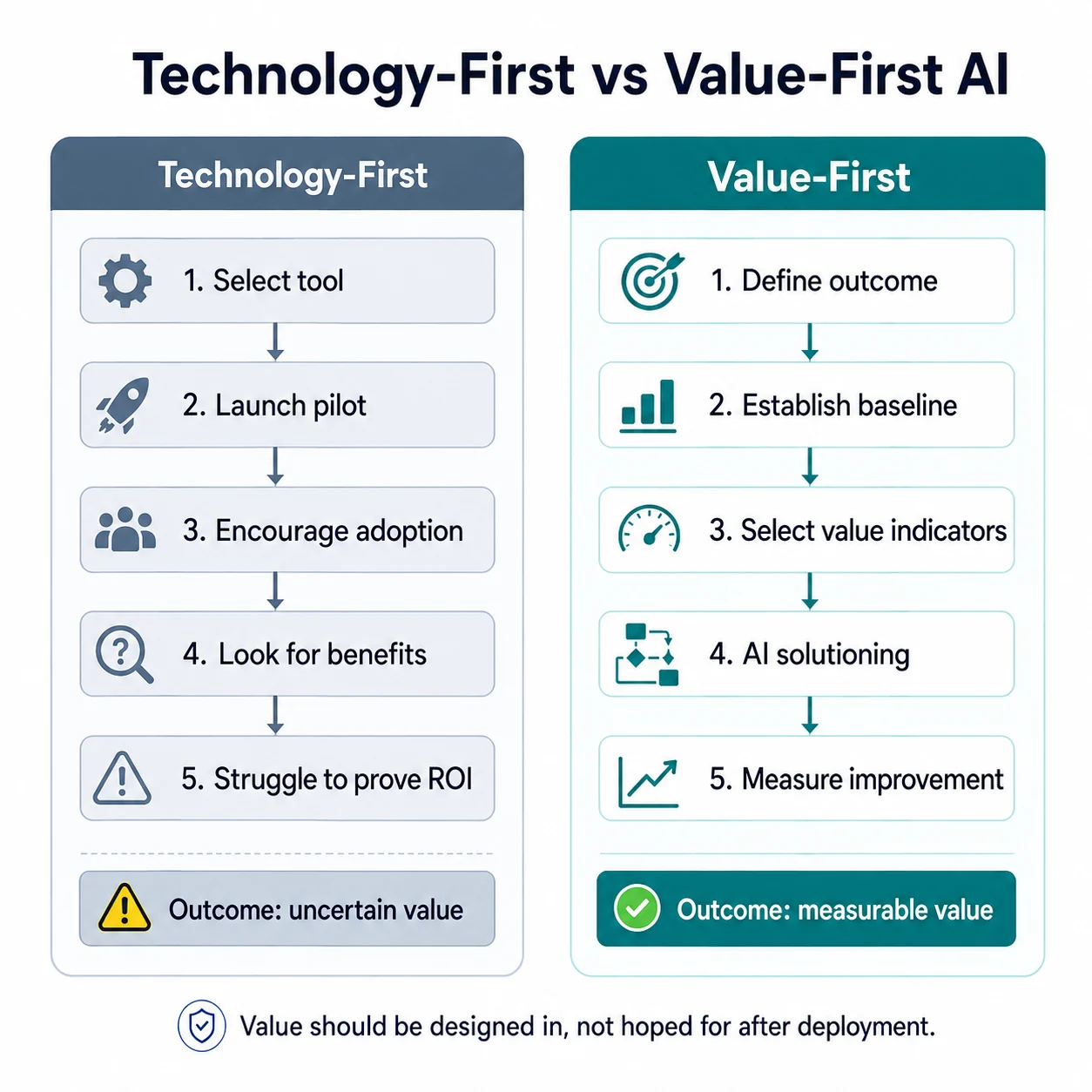
A technology-first approach tends to produce pilots, proofs of concept, and broad access to general-purpose tools. These can be useful, but they often leave organizational value as an aspirational by-product. The organization deploys the tool, encourages adoption, and then tries to find evidence of benefit after the fact.
A value-first approach reverses the logic. It begins with the outcome, defines the baseline, selects the measure, redesigns the work, and then determines where AI can make a meaningful contribution.
In other words, AI value should not be something we hope to discover after deployment. It should be designed into the initiative from the beginning.
Why AI ROI is proving elusive
One reason AI return is difficult to demonstrate is that organizations often begin with broad aspirations rather than specific outcomes.
Leaders frequently describe their objective as improving “efficiency,” or increasing “productivity”. These are reasonable ambitions, but they're not measures. Without a clear indicator, it becomes difficult to determine whether an AI initiative has succeeded, how much value it has created, or whether the investment should be expanded.
The challenge is that efficiency can mean many different things. Does it mean processing more applications with the same staff? Reducing turnaround times? Improving service quality while maintaining costs? Lowering error rates? Reducing risk?
So the more useful question is: efficient at what? Leaders should be framing the question in terms of how AI can be deployed to measurably improve its ability to deliver.
The better starting point: value indicators
If leaders want AI investments to produce measurable value, they should begin by identifying the concrete value they expect.
The effect of this approach is to turn AI adoption into an exercise in business architecture rather than one focused solely on AI technology. Instead of starting with a tool and searching for a use case, leaders begin by examining how work is performed, where value is created, where bottlenecks exist, and which outcomes matter most. AI then becomes one component of a broader redesign effort that may also involve changes to processes, roles, decision points, governance, and performance measures.
Viewed this way, the question is no longer simply whether AI can automate or accelerate a task. The more important question is how AI can contribute to a specific organizational outcome that can be observed, measured, and improved over time. Different initiatives create value in different ways, which is why organizations should identify the primary value indicator before selecting or deploying an AI solution.
Let’s look at the primary indicators that leaders should use as foundations for their AI investments.
1. Productivity and throughput
Leveraging AI to complete more work in the same period of time with the same workforce.
This is the classic productivity argument: more files reviewed, more cases processed, more applications assessed, more reports produced, or more client requests handled at constant staffing levels.
But the measure must be concrete. “Hours saved” is not enough. The stronger question is whether those saved hours translate into increased throughput, backlog reduction, reduced overtime, avoided hiring, or reduced dependence on contractors.
A credible productivity measure might be applications reviewed per assessor per week, average handling time per case, number of completed transactions per full-time equivalent, or backlog reduction over a defined period.
2. Quality, consistency, and defensibility
Leveraging AI to improve the quality or consistency of outputs compared with the human-only baseline.
This is especially important where work involves judgment, documentation, compliance, or fairness. In many organizations, the value of AI may not be that it produces faster decisions, but that it supports more complete, consistent, and defensible ones.
Possible measures include error rates, rework rates, variance among reviewers, completeness of documentation, alignment with a gold-standard assessment, policy compliance, or supervisor correction rates.
For government, this category is particularly important. A decision that is faster but less consistent is not a success. A decision that is faster, more transparent, better documented, and more consistently aligned with policy may be.
3. Service levels
Leveraging AI to improve the experience of the stakeholder receiving the service.
Service value can show up as reduced cycle time, faster response, better status visibility, fewer handoffs, fewer resubmissions, or improved compliance with service standards.
This is distinct from internal productivity. A process may become more responsive to the client even if total internal effort does not fall dramatically. For example, AI may help identify incomplete applications earlier, route requests more accurately, or provide clearer guidance before a file enters a formal review process.
The value is not simply that employees work faster. The value is that the service performs better.
4. Cost avoidance and capacity preservation
Leveraging AI to allow the organization to absorb growing demand without proportional growth in staffing or spending?
This is often one of the most realistic value categories in the public sector. AI may not immediately reduce headcount or budgets, but it may help an organization manage rising workload, increasing complexity, or new service expectations without equivalent growth in resources.
A strong cost-avoidance measure might be the ability to handle a 25 percent increase in application volume without adding FTEs, contractors, or overtime.
5. Risk reduction
Leveraging AI to reduce operational, compliance, financial, legal, reputational, or security risk.
Some of the most valuable AI applications may be preventative. They may identify anomalies, flag missing mandatory information, detect inconsistent treatment of similar cases, surface emerging reputational issues, or improve auditability.
Risk reduction can be harder to measure but avoided failures, non-compliance and reputational impacts matter. The key is to define the risk clearly and measure the AI contribution against a baseline.
6. Net-new or expanded capability
Leveraging AI to help the organization do something valuable that was previously impossible, too slow, or too labour-intensive?
This is where AI’s value can extend beyond the organization’s current scope. AI can allow organizations to monitor larger information environments, compare more evidence, generate more scenarios, implement new programs, or provide service in ways that were previously impractical.
For example, a government organization may not currently have the staffing ability to institute an additional grants program that has been on the drawing board. AI may make this new capability feasible with current staffing.
The value is not that AI reduces the cost of an existing process. The value is that it expands what the organization is capable of doing.
7. Decision quality
Leveraging AI to help leaders make better, faster, more evidence-based decisions.
This category needs discipline because “better decision-making” can become vague quickly. The question should be specific: Does AI improve the evidence base? Does it reduce blind spots? Does it enable better forecasting? Does it support scenario analysis? Does it improve prioritization? Does it identify risks or opportunities earlier?
Decision-support AI should be judged not by whether it produces impressive summaries, but by whether it improves the quality, timeliness, or reliability of decisions.
8. Institutional resilience
Leveraging AI to help the organization retain, retrieve, and reuse knowledge.
This is often overlooked. Many organizations depend heavily on tacit knowledge: experienced staff, historical decisions, old briefing material, policy interpretations, case precedents, and undocumented practices.
AI can create value by making institutional knowledge more accessible and less dependent on a small number of experts. Measures might include onboarding time, search time, reuse of prior work, reduced dependence on key individuals, or improved consistency in applying past decisions and guidance.
In organizations facing retirements, turnover, contractor dependence, or knowledge fragmentation, this can be a significant source of value.
From technology deployment to value design
The practical implication is straightforward: every AI initiative should begin with a value design conversation.
Before selecting the tool, model, vendor, or platform, leaders should be asking:
1. What outcome are we trying to improve?
2. What is the current baseline?
3. Which value indicator matters most?
4. How will we measure improvement?
5. What workflow change is required?
6. What human decision or review point must remain?
7. What data, systems, and controls are needed?
8. What would count as success after three months, six months, or one year?
These questions move AI from experimentation to disciplined and value-focused investment. They also help distinguish between AI that is merely available and AI that is actually useful.
The leadership challenge
AI has made experimentation easier, which is good. But it has also made unfocused adoption easier which has the side-effect of placing the technology ahead of ROI.
The availability of powerful AI tools can create the false illusion that value will naturally follow deployment. Instead, value follows design, integration, measurement, adoption, and management.
Leaders don't need to become AI engineers. But they do need to become more disciplined sponsors of AI-enabled value. They need to insist that AI initiatives be tied to measurable organizational outcomes from the beginning.
Originally published on LinkedIn, June 2, 2026.