Hours Saved but Nothing Banked: The Five Disciplines That Turn Government AI Efficiencies into Budget Reality
Introduction
Across the Government of Canada, departments are under pressure to use AI to improve productivity, strengthen services and help absorb growing demands within shrinking budgets. AI unquestionably creates new opportunities to perform knowledge work faster and at lower effort. But faster work is not the same thing as realized organizational value. Hours saved at employees’ desks do not automatically reduce a departmental budget, increase program capacity, improve a service standard or reduce risk. Those outcomes occur only when management deliberately designs their AI projects to capture them. This article examines five management disciplines that can help federal departments move beyond simple claims of “efficiencies” and realize benefits that are measurable in terms of bottom-line departmental metrics.
The value harvest that never happened
Consider the scenario: The AI pilot worked - a document-summarization tool deployed to a program office; ninety minutes saved per officer each week; enthusiastic testimonials; and a projected 7,800 hours of annual capacity returned to the department. The deck circulated, the steering committee applauded, and the pilot was declared a success. Its rollout was expanded.
One year later, try to find the 7,800 hours.
The program office’s budget is unchanged. So are its service standards, organizational structure, staffing plan and backlog. The hours were saved in the narrow sense that individual officers genuinely spent less time summarizing documents. But they were banked nowhere. Small fragments of time scattered across many desks never accumulated into anything a deputy head, chief financial officer or program executive could identify and redeploy.
The capacity was simply absorbed into the workday, being consumed by existing demand, administrative overhead, or “busywork” that would otherwise not have been pursued. The department is left with a compelling success story that cannot be found in its budget, its service performance, or the departmental results report.
This is not a technology failure. For the most part, it is not a talent failure either. It is a failure in organizational value capture.
Some or all of five conditions were missing when the project was approved. Once they were absent, no amount of downstream delivery excellence could fully compensate, because the value had never been given a destination. The project was designed to produce an efficiency but was not designed to harvest it.
Discipline #1: Focus on mandate-level results, not task-level AI capabilities
The first discipline is deceptively simple: The AI transformation projects must begin with a departmental result, not with a promising AI capability.
“Summarize documents faster” describes what a tool does. It is not a business outcome. A useful project statement sounds different: reduce the average time required to assess an application from twelve days to three; clear a backlog without additional staffing; increase the proportion of files completed within the service standard; reduce payment errors; or allow a compliance team to examine twice as many high-risk transactions.
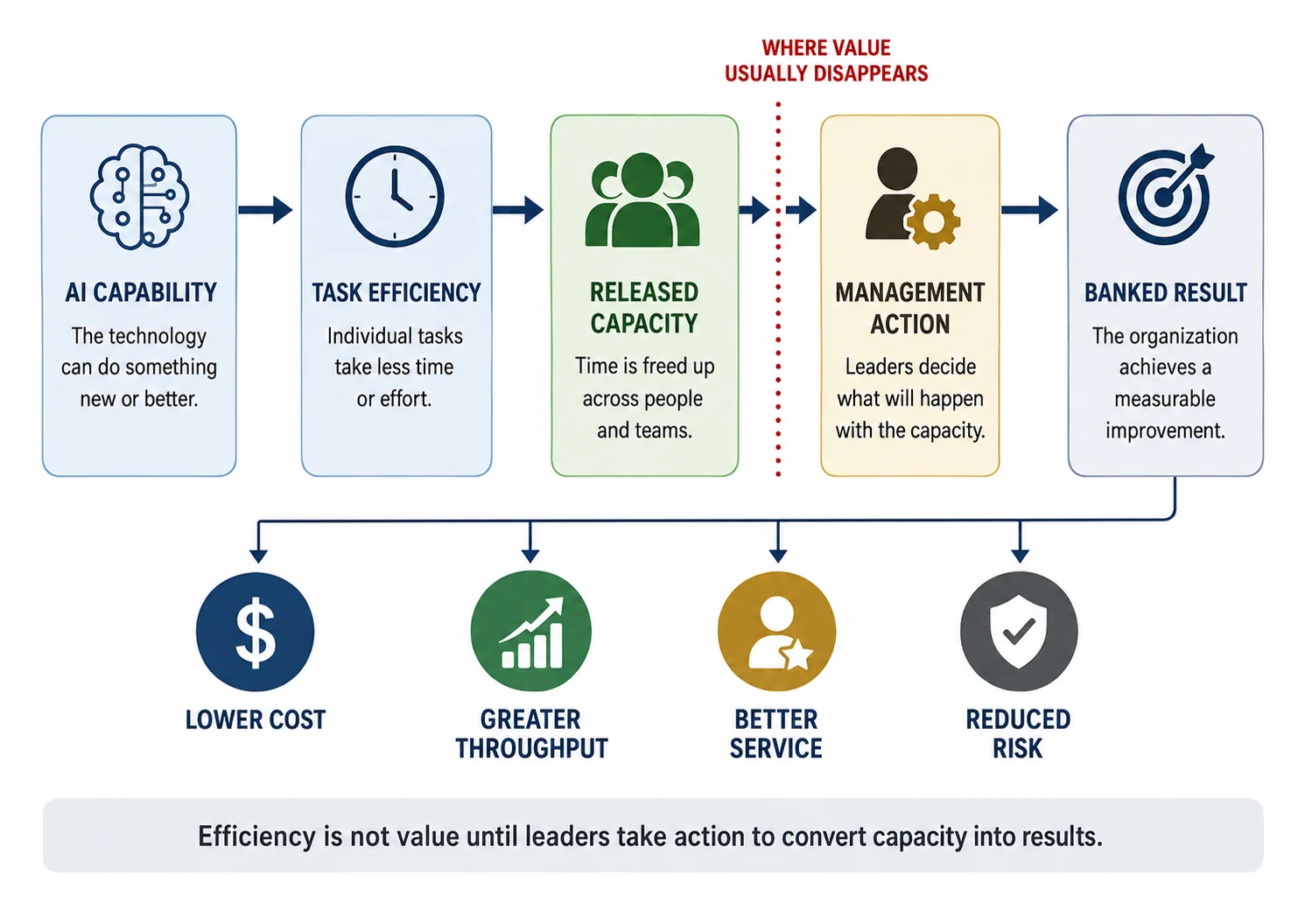
This distinction matters because a technology team can deliver a functioning tool without changing any of those outcomes. Unless the project is tied to a measure that the program already manages (or should manage) the department may know that the AI is being used yet be unable to say whether it made the program better.
Before approval, every project should therefore have a baseline, a target, a transaction volume and a credible method of attribution. The baseline answers, 'What happens today?' The target answers, 'What will be materially different?' Attribution answers, 'How will we know that the AI, rather than some unrelated change, caused the improvement?'
This logic is already embedded in the Departmental Results Framework. Programs are expected to define intended results, maintain performance information and use evidence in decision-making. Federal AI guidance points in the same direction. Opportunities should provide clear business value, be feasible and scalable, and have their performance measured throughout the lifecycle.
The approval question should be: Which departmental result will this opportunity move, by how much, and by when?
Discipline #2: Decide in advance where the released capacity will go
The second discipline is the one most often skipped.
An hour saved through AI is not automatically a dollar saved. Nor is it automatically better service. It becomes valuable only when leadership decides what will happen to the released capacity.
There are several legitimate destinations. The department might reduce overtime or contracting. It might avoid future hiring as workload grows. It might clear a backlog, expand a service, shorten processing times, improve the quality of decisions or move employees from routine work to higher-value analysis.
These are all real benefits, but they are not interchangeable, and they should not all be labelled “savings.”
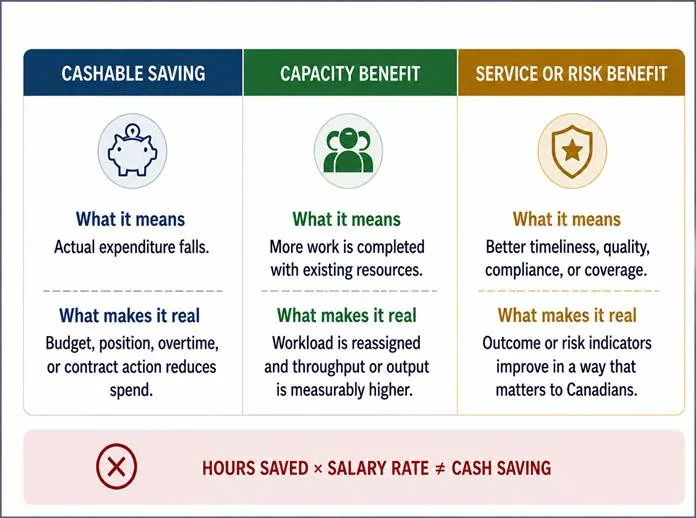
A project claiming financial savings should identify the budget mechanism that will produce them. Will positions be reduced through attrition? Will planned hiring be avoided? Will a contract be scaled back? Will overtime fall?
Without such an action, multiplying estimated hours by an average salary produces a monetized fiction and not a bankable saving.
Capacity benefits require equal discipline. If employees will use the time to perform more valuable work, that work should be named, assigned and measured. Otherwise, the time will be absorbed by the normal elasticity of organizational demand. There is always more email to answer, more material to review and more meetings that can fill the calendar.
Every significant AI project therefore needs a business benefits owner (ideally the operational DG or ADM, and not the technology lead) and a benefits realization plan validated by finance. The owner is accountable not just for deploying the system, but for ensuring that the promised capacity reaches its intended destination.
The approval question should be: What management action will convert the efficiency into a budget, service, capacity or risk result?
Discipline #3: Redesign the workflow, not just the task
The third discipline is to treat AI as an operating-model intervention.
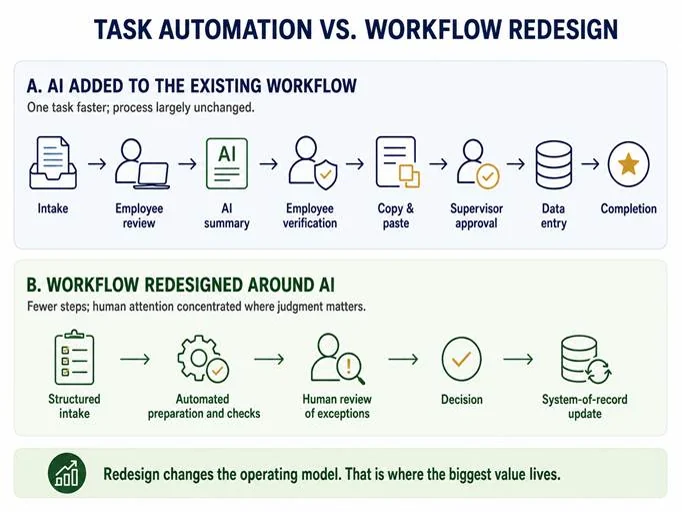
Most current GC AI projects are inserted into existing work. An employee receives a document, opens a separate tool, asks for a summary, checks the output, copies it into another system and continues through the same sequence of hand-offs and approvals. One task is faster, but the process remains largely intact.
That can be useful, particularly while departments learn, but it rarely produces transformational value.
The larger gains come when the department examines the full workflow. Could information be captured correctly at intake? Could low-risk cases move through a simpler path? Could AI prepare a structured assessment rather than an unstructured summary? Could human review focus on exceptions, ambiguity and consequences rather than re-performing routine checks? Could redundant approvals or duplicate data entry be removed? Could outputs flow directly into the system of record?
Private-sector evidence increasingly points in this direction. Controlled studies have shown that AI can deliver substantial task-level improvements, although performance varies sharply by task and can become worse when the technology is used beyond its capabilities. Broader enterprise surveys find that organizations reporting the greatest value are far more likely to redesign workflows and have active senior leadership ownership.
Workflow redesign must include people, not just process diagrams. Roles, accountabilities, quality controls, training and workload expectations will change. Employees and bargaining agents should be engaged early enough to shape the design, not simply informed after a system has been selected. Federal guidance on generative AI likewise emphasizes multidisciplinary engagement and responsible deployment.
Increasing evidence indicates that this exercise is best completed using integrated tiger teams that include senior operational and technical representation.
The approval question should be: If the AI performs as expected, what will actually change in the way the program operates?
Discipline #4: Prove operational performance and count the full cost
The fourth discipline is gathering evidence that the proposed system will be robust enough to survive contact with production.
Pilots often benefit from selected data, close support, motivated users and limited volumes. Production introduces old systems, incomplete records, unusual cases, seasonal surges, employee turnover, adversarial behaviour and consequences when the answer is wrong.
A polished demonstration establishes possibility but does not establish operational value.
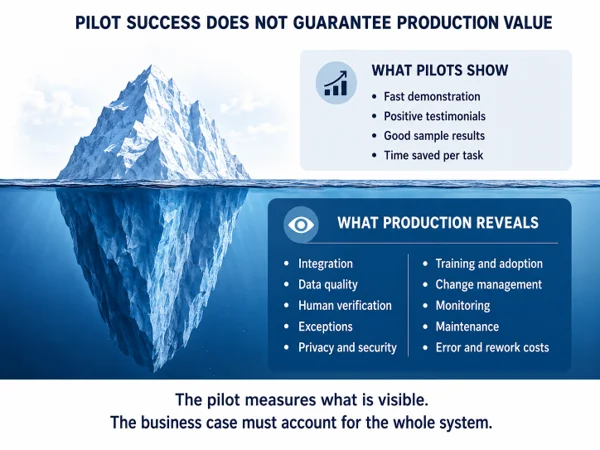
Evaluation should be designed before development begins. Departments should define representative test cases, comparison methods, required accuracy, acceptable failure rates, human-review rules, processing time, adoption targets and the consequences of error. Measures should include the entire process, not just the seconds consumed by the AI model.
The economic calculation must also include the full lifecycle: data preparation and integration, licenses and model usage, privacy, security and accessibility work, testing and quality assurance, employee training and change management, human verification and exception handling, and ongoing monitoring and maintenance.
A tool that saves time at the desktop may still increase total process cost if it creates new review work or expensive exceptions.
Risk management and value measurement should reinforce each other. The federal Directive on Automated Decision-Making is intended not only to reduce risks, but also to support more efficient, accurate, consistent and interpretable decisions. The appropriate controls will vary with impact, but they cannot be treated as paperwork added after the business case.
Projects should pass through evidence-based gates: problem validation, prototype, controlled pilot, limited production and scale. Each gate should have a genuine stop decision.
Continuing because money has already been spent is not prudent innovation.
The approval question should be: After all costs, controls, errors and human effort are included, is the result still materially better than the baseline?
Discipline #5: Govern AI as an investment portfolio
The fifth discipline sits above the individual project.
Departments have no shortage of plausible AI ideas. Their scarce resources are executive attention, experienced data and technology staff, security, and the willingness of programs to redesign work. Spreading these resources across dozens of unrelated pilots creates activity, not transformation.
AI investments should therefore be compared as a portfolio using common criteria: expected public and departmental value, strategic alignment, feasibility, total lifecycle cost, operational risk, scalability and reuse potential, and the probability that benefits can actually be harvested.
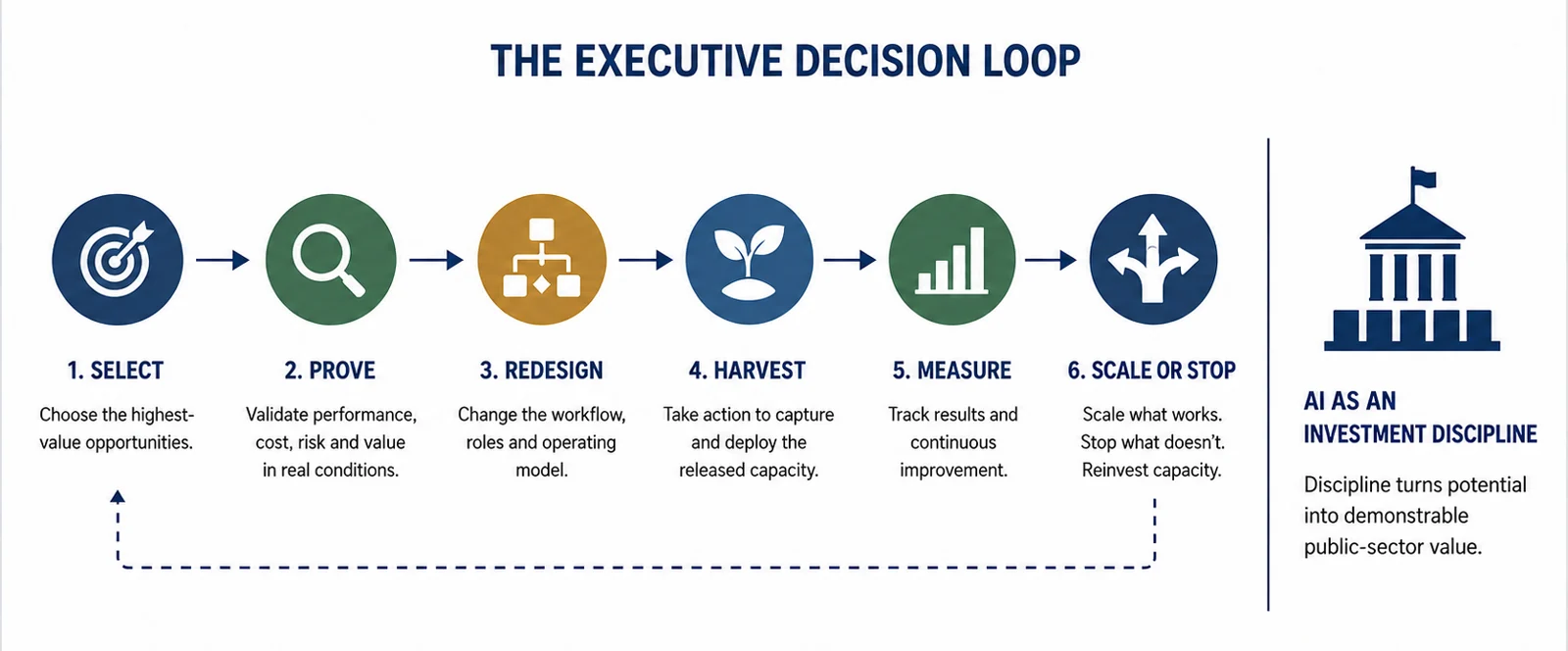
es not mean every idea has to pass through a slow central committee. Proportionate governance is the key. Low-risk experimentation can remain lightweight. Material investments and systems affecting programs, services or decisions should face stronger scrutiny and clearer executive accountability.
A departmental portfolio view also exposes opportunities that project-by-project governance misses. Several programs may need the same document-processing capability, evaluation method, protected environment or human-review pattern. Reusing those assets lowers cost and risk. It also allows scarce specialist capacity to be concentrated on the few initiatives capable of producing material results.
The governance committee should include program leadership, finance, the chief information and data functions, human resources, security, legal services and results or evaluation expertise as appropriate. The committee’s role is to test whether the proposed investment can produce and capture value.
The portfolio questions should be: Is this among the department’s best AI opportunities? What must stop or wait if it proceeds? What reusable capability will remain after the project?
Conclusion
There is broad evidence that bears out these disciplines. Task-level studies show that the technology can make some kinds of knowledge work faster and better. At the same time, enterprise surveys find that 84% of organizations stated to be implementing AI still struggle to identify material enterprise-wide productivity effects. The gap is executive understanding of how to cultivate and harvest organizational value from AI-generated efficiencies.
AI creates the possibility of realized value but does not decide which departmental result matters, remove obsolete process steps, redirect released capacity, change a staffing plan, or reduce a contract. Those are executive decisions.
The five management disciplines are therefore:
1. Anchor the investment in a measurable departmental result.
2. Specify how the benefit will be captured.
3. Redesign the end-to-end workflow and operating model.
4. Prove performance and net value under real operating conditions.
5. Manage AI as a prioritized portfolio, with the courage to stop projects that cannot demonstrate value.
When they are absent, the readout deck may still look excellent, but no departmental value will be harvested.
When these conditions are present, an AI project can produce something a deputy head, program executive and chief financial officer can all recognize: a better result delivered through demonstrably better use of public resources.
Originally published on LinkedIn, September 14, 2026.