Seizing the AI Dividend: Funding Carney's Defence Pledge through Strategic AI Investment in the Public Service
How Canada can leverage artificial intelligence to fund increased defence spending while modernizing government operations
The Perfect Storm: A Unique Opportunity for Transformation
Canada stands at a critical juncture. Prime Minister Mark Carney has committed to meeting NATO's 2% GDP defence spending target—a pledge that requires an additional $9.3 billion annually. Simultaneously, the federal public service has grown by an unprecedented 43% since 2015, creating a workforce of nearly 370,000 employees with an annual compensation cost exceeding $46 billion.

This proposal is not austerity for its own sake. It is a strategic re‑allocation: empowering our skilled people to move from high-volume, routine administration into tackling priority challenges - starting with defence. With advanced AI now mature, and fiscal and political conditions aligned, Canada has a once‑in‑a‑generation opportunity to redesign, not merely downsize, the machinery of government.
The Fiscal Reality: Understanding the Scale

Federal Public Service Growth Trajectory
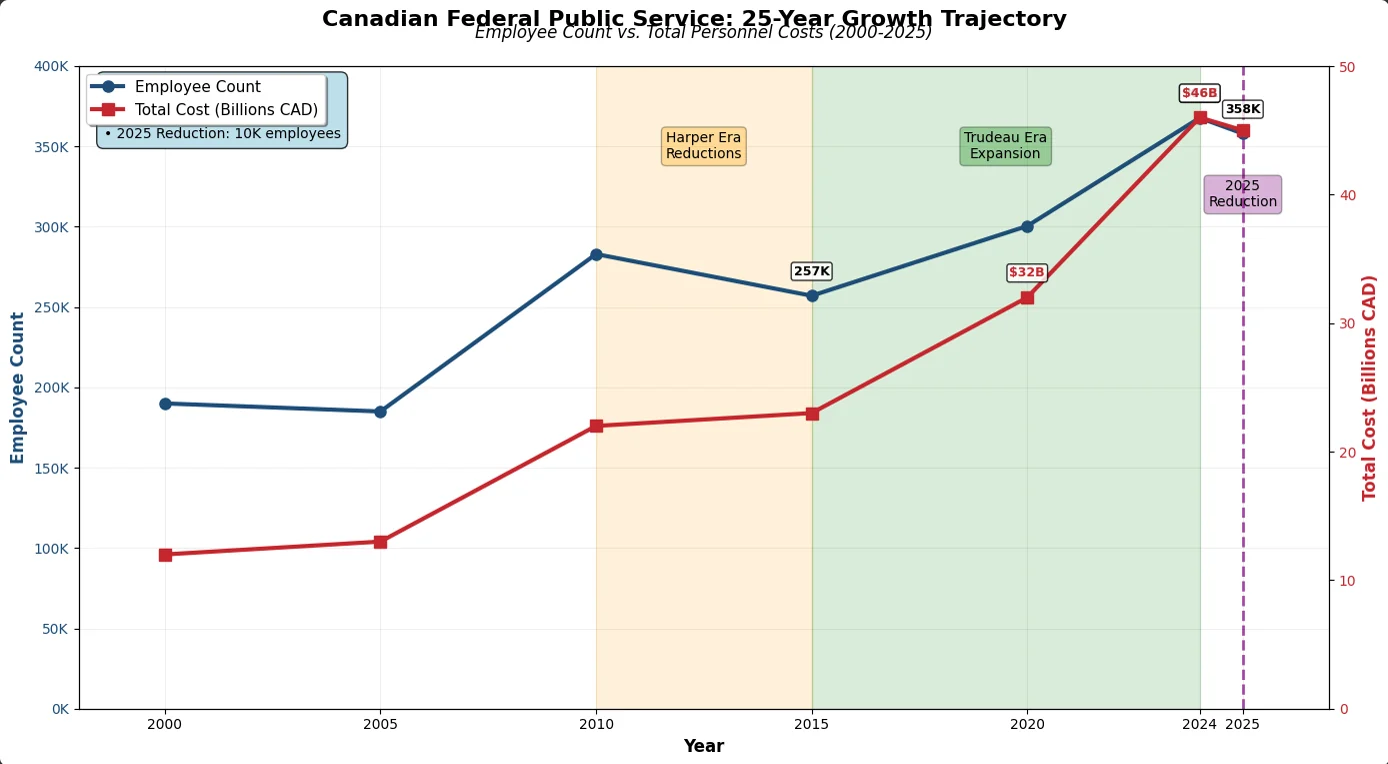
This growth trajectory, while addressing legitimate service demands, has created fiscal pressures that traditional budget approaches cannot resolve. With Carney's defence commitment requiring $9.3 billion in new spending, Canada faces three unpalatable options: tax increases, deeper program cuts, or significant debt expansion.
However, there's now a fourth option that transforms challenge into opportunity: strategic AI investment that optimizes government operations while redirecting savings to national defence priorities.
The AI Dividend: Quantifying the Opportunity
Unprecedented levels of investment by the AI industry has resulted in the availability of tools and capabilities that allow advanced AI to be integrated into existing processes and workflows resulting in a new "digital labour" resource available to workforce planners. In most cases today, digital labour is used to augment human performance through a combination of increased output, faster decision making, or improved quality. Also possible is the creation of entirely new workflows that leverage AI's native capabilities. In these cases, humans work with AI in a role akin to supervision, identifying when and where to intervene and provide guidance.
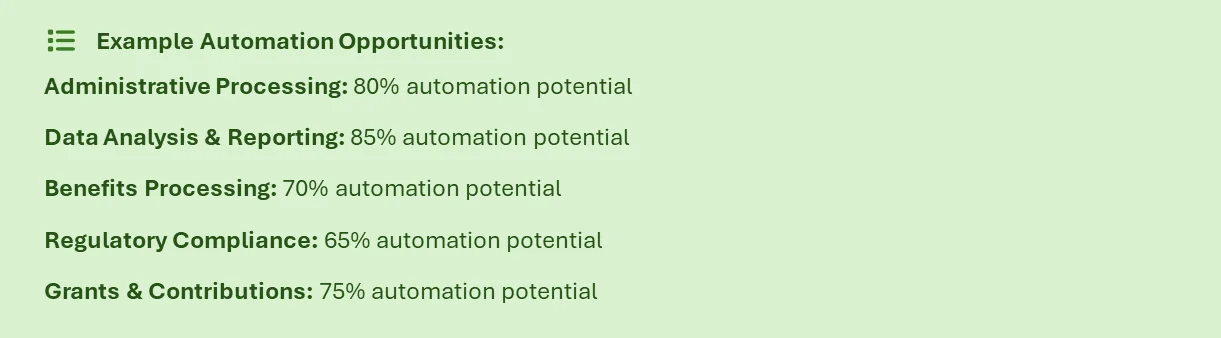
In either case, the potential for AI to generate measurable ROI in the public sector is no longer theory - it's a present reality that is transforming how governments operate worldwide. Current AI capabilities can handle 60-85% of routine government tasks, from document processing and data analysis to customer service and regulatory compliance. It is also becoming increasingly competent in non-routine cognitive tasks such as policy review and strategy development.
Potential Savings Scenarios
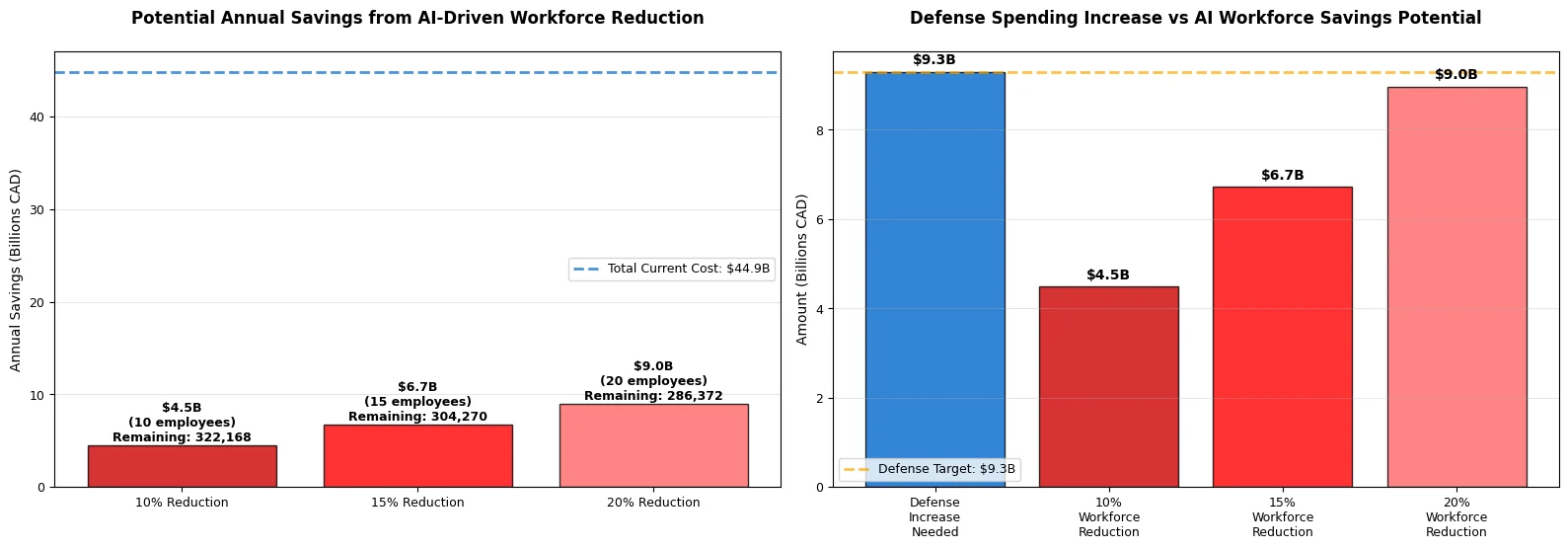
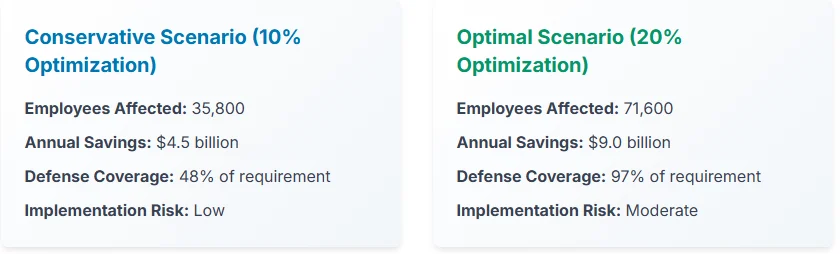
These aren't theoretical projections. They're based on documented AI capabilities already transforming private sector operations and government functions internationally. The key insight: AI can perform routine cognitive tasks more efficiently, accurately, and cost-effectively than traditional approaches.
Learning from Global Leaders
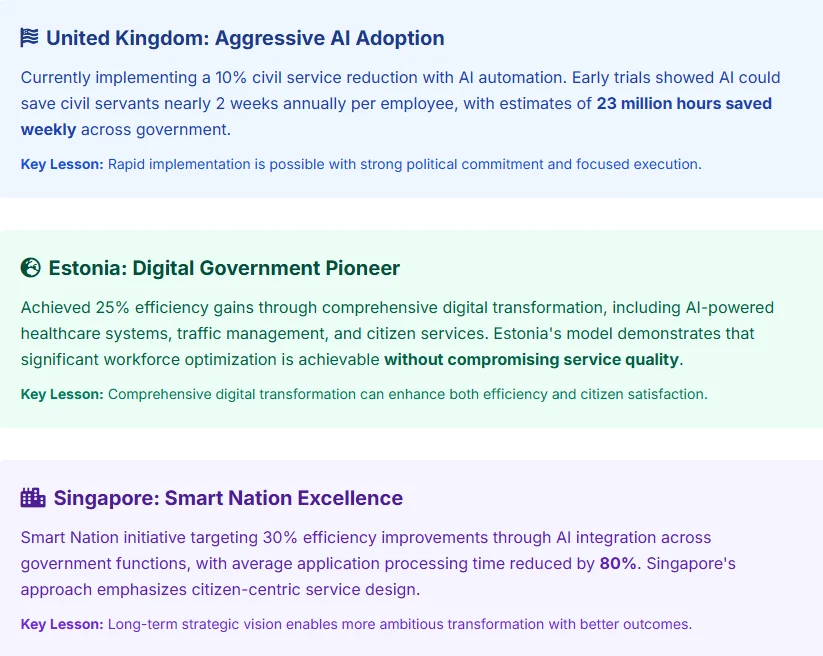
Canada isn't pioneering this approach—we're following established models. Three countries demonstrate different pathways to AI-driven government transformation, each offering valuable lessons for Canadian implementation.
Strategic Implementation: A Phased Approach
Success requires careful orchestration across multiple dimensions. The optimal approach balances ambition with risk management, ensuring transformation doesn't compromise government effectiveness during implementation.
Phase 1: Foundation Building (2025-2026)
Target: 2-8% workforce optimization
Launch pilot programs in high-automation departments
Establish AI governance framework and standards
Begin comprehensive change management processes
Implement hiring freezes and voluntary separation programs
Phase 2: Acceleration (2027-2028)
Target: 15% workforce optimization
Full-scale AI implementation across departments
Department-by-department transformation programs
Comprehensive retraining and reskilling initiatives
Service delivery optimization and citizen experience enhancement
Phase 3: Optimization (2029-2030)
Target: 20% workforce optimization
Fine-tuning AI systems for maximum efficiency
Complete workforce reshaping and role redefinition
Performance monitoring and continuous improvement
Full integration with defence spending requirements

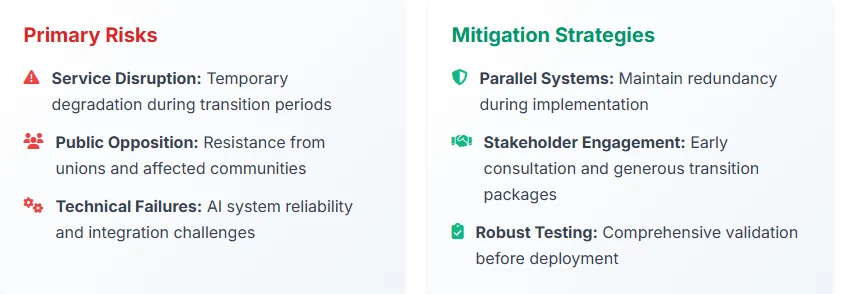
Managing Transformation Risks
Reducing public service employment through AI adoption invariably raises sensitive issues concerning job security, employee morale, and political viability. Effective management of these concerns necessitates strategic framing of AI adoption as a vital modernization effort aimed at enhancing service responsiveness and efficiency rather than mere cost-cutting.
Transparent communication, accompanied by comprehensive re-skilling programs and voluntary attrition incentives, will be essential in managing public perception and union reactions.
The Economic Multiplier Effect
The benefits extend far beyond immediate budget relief. Strategic AI investment creates positive economic multipliers that strengthen Canada's competitive position while enhancing government effectiveness.

Direct Benefits
Immediate budget relief enabling defence spending without tax increases
Enhanced government responsiveness and service quality
Reduced administrative burden on citizens and businesses
Indirect Benefits
Stronger Canadian AI sector development and global competitiveness
Enhanced data-driven policy making capabilities
Improved citizen trust through better service delivery
Strategic Benefits
Defence capability enhancement without fiscal strain
Government modernization positioning Canada as a digital leader
Workforce skills development for the digital economy
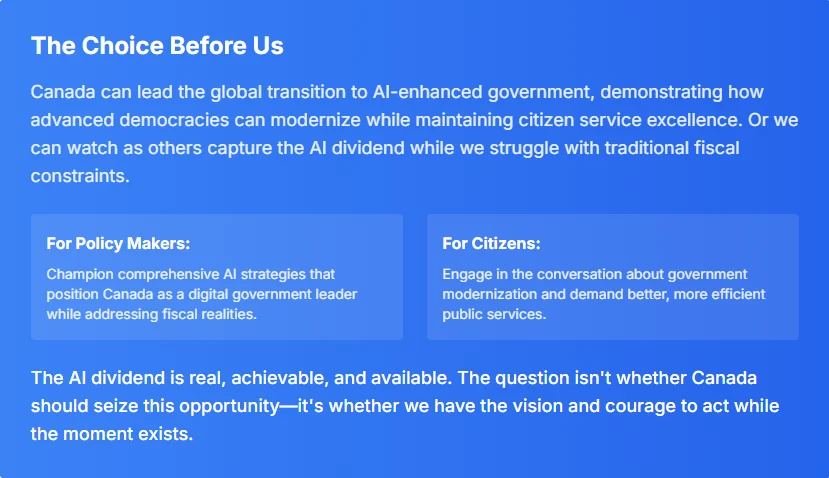
The Path Forward: Seizing the Moment
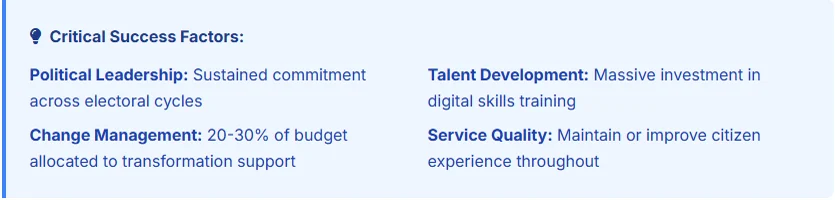
Canada faces a unique convergence of opportunity and necessity. Prime Minister Carney's defence commitment creates both the urgency and political cover for transformation. Advanced AI capabilities provide the technical means. International examples demonstrate feasibility. The fiscal mathematics are compelling.
In addition, the window for action is limited. AI capabilities are advancing rapidly, making early adoption increasingly advantageous. International competitors are already implementing similar strategies. Most importantly, the political alignment between defence spending requirements and workforce optimization creates a narrative that transcends traditional partisan divisions.

This isn't about downsizing government—it's about rightsizing it for the digital age. The goal isn't fewer civil servants doing less work, but rather optimally allocated human resources doing higher-value work while AI handles routine tasks more efficiently.
Success requires exceptional execution across multiple dimensions: technical implementation, change management, stakeholder engagement, and political leadership. However, the potential rewards—enhanced national defence, modernized government operations, and fiscal sustainability—justify the ambition.
Originally published on LinkedIn, June 17, 2025.