AI with Impact: A Benefits-Driven Blueprint for Canada's Strained Public Service
Introduction: The Perfect Storm
The Canadian federal public service finds itself navigating a perfect storm. Domestic economic realities, marked by persistent inflation concerns, a soft labour market, and significant fiscal pressures, are converging with geopolitical uncertainty highlight increased uncertainty weighing on confidence and investment. This environment translates into intense pressure on government departments. There's an undeniable need to streamline, to find efficiencies, and to downsize – where estimates hover around 15 to 20% in cuts to come.
This creates a stark dilemma: how can the government maintain, let alone improve, services for Canadians when resources are shrinking, and workload demands continue to grow? Departments face genuine risks – reduced service quality, loss of institutional knowledge as staff depart, compliance challenges, and potentially unfulfilled mandates. In this context, Artificial Intelligence (AI) inevitably enters the conversation. It’s frequently touted as a silver bullet, a technological force capable of revolutionizing operations. But is it living up to the hype?
AI in Government: Promise vs. Reality
The allure of AI is understandable. The potential to automate repetitive tasks, streamline complex processes, extract powerful insights from vast datasets, enhance citizen interactions through tools like chatbots, and ultimately free up employees for higher-value strategic work is immense. AI promises not just efficiency gains but also enhanced service delivery and more informed, evidence-based decision-making.
However, the reality on the ground has often been muted. Despite growing interest and investment, the adoption of AI across the federal government has been cautious, and transformative, measurable benefits remain scarce. While several “toe dipping” projects have begun, departments struggle to capture sufficient value from their AI initiatives. A main theme is that initial enthusiasm has led to technology-driven projects that lack clear objectives or fail to integrate effectively into existing workflows.
Recognizing both the potential, the Treasury Board of Canada Secretariat (TBS) recently launched Canada's first-ever AI Strategy for the federal public service ("AI Strategy for the Federal Public Service 2025-2027"). The strategy emphasizes key priorities: establishing central expertise and coordination, ensuring security and responsibility, developing talent, and building public trust through transparency.
Yet, while the TBS strategy provides the vital 'what' and 'why', it leaves a gap regarding the 'how'. It acknowledges barriers like legacy systems and departmental processes but doesn't prescribe the specific methodologies departments need to systematically identify, prioritize, implement, and measure the benefits of AI investments to ensure they translate into tangible improvements and demonstrable return on investment (ROI). This gap between strategic intent and practical execution is where many AI ambitions falter. How can departments move beyond isolated experiments or hype-driven acquisitions towards truly harnessing AI's power?
The Need for Benefits-Driven AI Investment
The answer lies in shifting the fundamental approach: moving from a technology-centric view to a Benefits-Driven AI Investment strategy. This isn't just a new name for project management; it's a paradigm shift focused squarely on achieving measurable mission impact.
Instead of asking "What can AI do?", the Benefits-Driven approach asks:
"Where are our most significant operational pain points, service delivery challenges, or mandate pressures?"
"Which specific, measurable benefits (e.g., reduced processing time by X%, improved compliance by Y%, cost savings of Z$, enhanced citizen satisfaction scores) can AI help us achieve in addressing these needs?"
"How can we prioritize AI use cases to generate the highest, demonstrable return on investment and align most closely with our strategic objectives?"
"How will we actively track and validate that these benefits are being realized?"
This contrasts sharply with technology-first approaches where departments might adopt an AI tool because it's novel or because of vendor promises, without a clear link to solving a defined business problem or achieving a quantified outcome. Rather than leaning into hype core AI investment principles should include:
Start with the Need, Not the Tech: Ground AI initiatives in clearly defined operational challenges or opportunities for service improvement identified through collaboration with functional subject matter experts (SMEs).
Define Measurable Benefits Upfront: Quantify the expected outcomes before development begins. Link these benefits directly to existing departmental performance indicators and strategic goals. Vague goals like "improve efficiency" are replaced with specific targets.
Prioritize Ruthlessly for Impact: Focus resources on AI applications with the highest potential ROI, greatest feasibility, and strongest alignment with core mandates. Not every potential AI use case is worth pursuing.
Adopt an Iterative and Agile Mindset: Pilot AI solutions on a smaller scale, rigorously measure their impact against baseline metrics, learn quickly, and then scale up successful applications. Avoid large, monolithic AI projects with distant payoff horizons.
Embed Strong Governance and Accountability: Establish clear leadership, roles, responsibilities, and decision-making processes. This includes ensuring ethical considerations, risk management (including security and privacy), compliance with TBS directives, and, critically, mechanisms for ongoing benefits tracking and realization. A departmental AI strategy should provide this guiding vision.
By anchoring AI investments in demonstrable benefits, departments can build stronger business cases, secure sustained funding, manage risks more effectively, and ultimately deliver greater value to Canadians.
The Benefits-Driven Methodology in Action
Implementing a Benefits-Driven AI approach requires a structured methodology, an end-to-end pipeline from idea to value realization. Based on practical frameworks, this typically involves distinct stages:
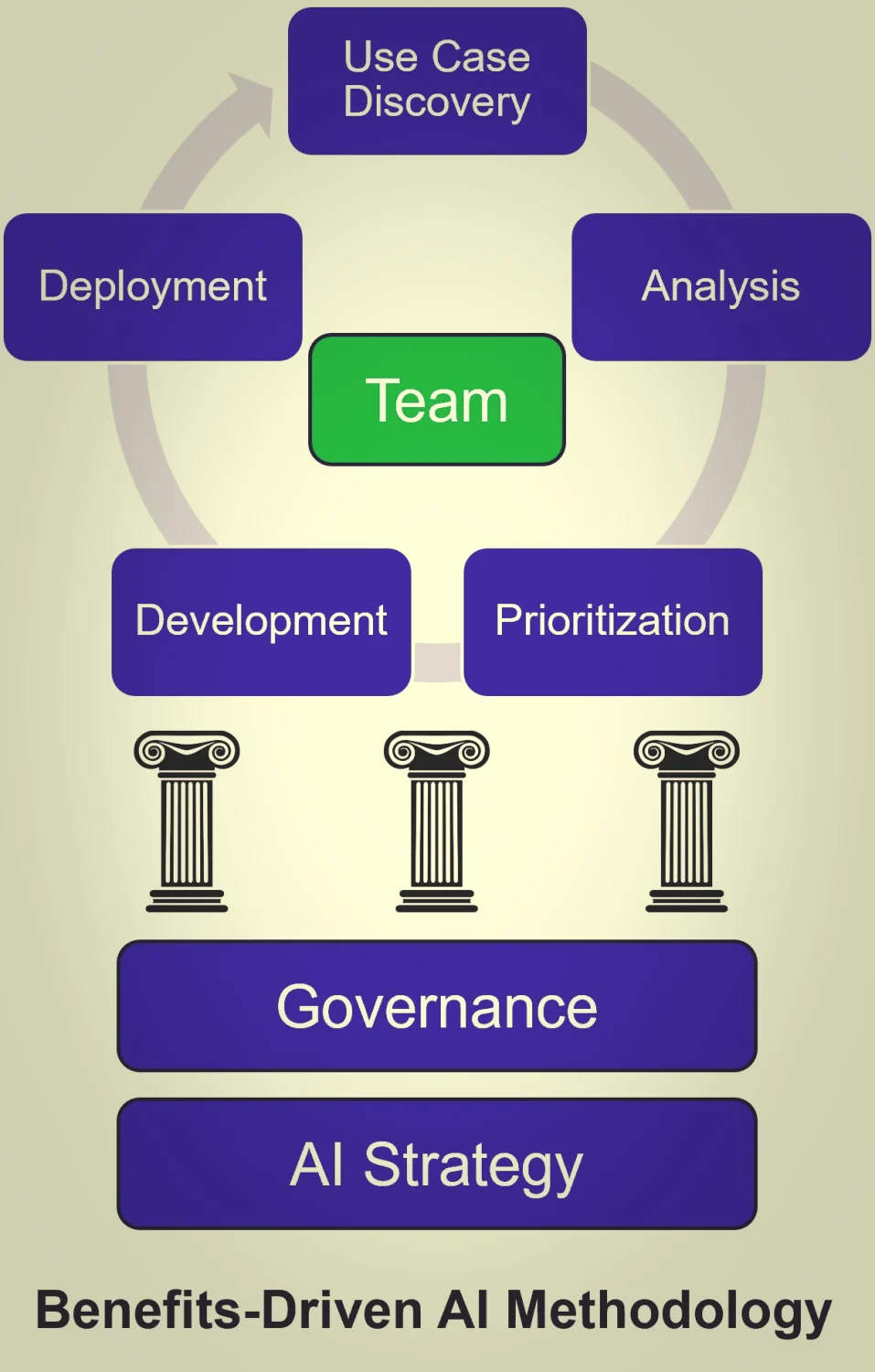
Use Case Discovery & Ideation: This crucial first step involves deep engagement with functional SMEs – the people who understand the operational realities. Multi-disciplinary teams (including process experts, business architects, data analysts, and AI engineers) work collaboratively in a bottom-up fashion to identify granular, specific potential use cases where AI could address pain points or unlock value. This isn't about finding uses for AI; it's about finding solutions for existing problems, where AI might be the best tool.
Analysis & Prioritization: Not all identified use cases are created equal. In this stage, candidate use cases are rigorously assessed against predefined criteria: Potential Benefit: How significant is the expected measurable impact (quantified ROI, efficiency gain, service improvement)? Feasibility: Is the required data available and of sufficient quality? Is the technology mature enough? Do we have the skills? Strategic Alignment: How well does this support core departmental objectives and the overarching AI strategy? Risk: What are the ethical, privacy, security, and operational risks, and can they be mitigated? Use cases are then prioritized based on this analysis, creating a roadmap of high-impact initiatives.
Development & Deployment: This involves building or procuring the AI solution, integrating it into existing workflows, and managing the change process. An agile approach is key, allowing for iteration based on user feedback and early testing. Procurement needs to shift towards being outcome-based, focusing on the results delivered rather than just technical specifications, and considering factors like interoperability and avoiding vendor lock-in.
Benefits Realization & Measurement: This stage is often overlooked but is central to the Benefits-Driven approach. It involves actively tracking the performance of the deployed AI solution against the baseline metrics and benefits defined in the Analysis stage. Did the solution actually reduce processing time by the targeted amount? Did compliance rates improve as expected? This requires ongoing monitoring and evaluation to validate the ROI and inform future iterations or scaling decisions. Strong governance ensures accountability for achieving these results.
A key advantage of this methodology is its potential to help government projects transcend the traditional 'iron triangle' of project management (scope, time, cost). While these constraints remain important, the primary driver becomes delivering the intended benefits. If a minor adjustment to scope or schedule allows for significantly greater benefit realization, that trade-off can be made consciously within the governance framework.
Making it Happen: Overcoming Barriers
Adopting a Benefits-Driven AI approach is not without challenges. Success requires addressing several key enablers and potential barriers often encountered in government AI adoption:
Leadership & Strategic Vision: Executive sponsorship is paramount. Leaders must champion the Benefits-Driven philosophy, articulate a clear departmental AI strategy that prioritizes measurable outcomes, and embed this approach within the organization's planning and governance structures.
Building Capacity & Skills: Implementing AI effectively requires more than just technical expertise. Departments need multi-disciplinary teams with skills in process analysis, business architecture, data science, change management, and benefits realization management. This may involve targeted training, strategic recruitment, or partnerships. Underestimating the need for training and support is a common pitfall.
Data Readiness: AI is data hungry. Poor data quality, accessibility issues, and data silos are significant impediments. A Benefits-Driven approach necessitates a parallel focus on data governance, quality improvement, and ensuring data is available and suitable for prioritized AI use cases.
Change Management & Culture: AI adoption fundamentally changes how work gets done. Addressing cultural resistance, building trust in AI systems (through transparency and clear explanations), ensuring user buy-in, and fostering a culture that supports experimentation and continuous learning are critical for success. Concerns around privacy and security must be proactively managed through robust governance and ethical frameworks.
Outcome-Focused Procurement: Traditional procurement models often struggle with the iterative nature of AI and the focus on outcomes. Shifting towards more flexible, agile, and outcome-based procurement practices is essential to acquire the right solutions and partners effectively. Prioritizing Canadian innovation and ensuring data sovereignty should also be considerations.
Sustainable AI: The environmental impact of AI (energy consumption for training and running models) is a growing concern. Sustainable AI practices, such as choosing energy-efficient solutions and optimizing models, should be integrated into the strategy and procurement decisions.
Conclusion: Towards Resilient and Effective Public Service
The Canadian federal public service stands at a critical juncture. The pressures are real, and the need for innovation is undeniable. While AI presents immense potential, simply investing in the technology is not enough. The slow uptake and limited ROI seen to date underscore the need for a more strategic, disciplined approach.
A Benefits-Driven AI Investment methodology offers that practical path forward. By anchoring AI initiatives in clear, measurable operational and service delivery improvements, departments can navigate the current fiscal challenges, mitigate the risks of downsizing, and truly harness AI's power. It allows leaders to make informed investment decisions, demonstrate tangible value for public funds, and ensure AI serves its ultimate purpose: enhancing the effectiveness, efficiency, and resilience of public service for all Canadians.
The time for ad-hoc experiments is over. It's time for government leaders to embrace a benefits-driven mindset, embedding this methodology into their departmental strategies and governance. This is how we move beyond the hype and ensure AI delivers on its profound promise, building a more modern, responsive, and resilient public service ready for the challenges and opportunities of the 21st century.
Find this interesting? Let's talk!
Originally published on LinkedIn, April 1, 2025.