Paying a Lot to Save a Little: Beware the AI Productivity Illusion
Why micro‑efficiencies don’t translate to macro benefits — and what leaders must do differently
Across the public and private sectors, organizations are racing to adopt artificial intelligence tools with the promise of unlocking new efficiencies. The logic is seductive: if every knowledge worker can save 10–15 minutes per day on routine tasks, surely the result is a net win in organizational productivity. Is this logic sound? Mostly, the answer is no. In fact, without a strategic approach, the rush to invest in AI can produce a negative ROI while yielding little to no improvement in key organizational indicators.
This article explores the illusion of AI productivity gains, especially as it relates to personal ‘assistant’ tools and ‘copilot’ suites that promise to streamline routine tasks. It unpacks why many of these investments fail to produce organizational benefits, identifies the systemic reasons behind these missteps, and lays out a pragmatic framework for leaders looking to avoid being caught in the same trap.
The AI Personal Productivity Illusion
In today’s AI vendor landscape, the loudest marketing messages often focus on solving low-hanging annoyances like generating emails, summarizing meetings, auto-assigning action items, and tidying your calendar. To the individual employee, these tools may appear quite beneficial — removing administrative overhead from their daily flow. But the problem is not what these tools do; the problem lies in what they fail to do: convert those micro-efficiencies into organizational value.
In practice, small efficiency gains at the individual level typically dissipate long before they become measurable organizational improvements. A recent U.S. Federal Reserve study found that even as some workers reported saving about 5.4% of their work time thanks to generative AI assistance (roughly 2 hours in a 40-hour week), the overall productivity boost for organizations was estimated at only about 1.1% in aggregate (The Impact of Generative AI on Work Productivity | St. Louis Fed). In other words, the impact on the bottom line was marginal – almost a rounding error. And the researchers cautioned that even this tiny uptick might not show up in official productivity metrics if workers simply use their extra time to take a breather rather than produce more output. Put bluntly, if an AI tool helps someone finish a routine task 10 minutes faster, there’s no guarantee they spend that 10 minutes on higher-value work.
Let’s summarize why micro‑efficiencies don’t scale to macro benefits.
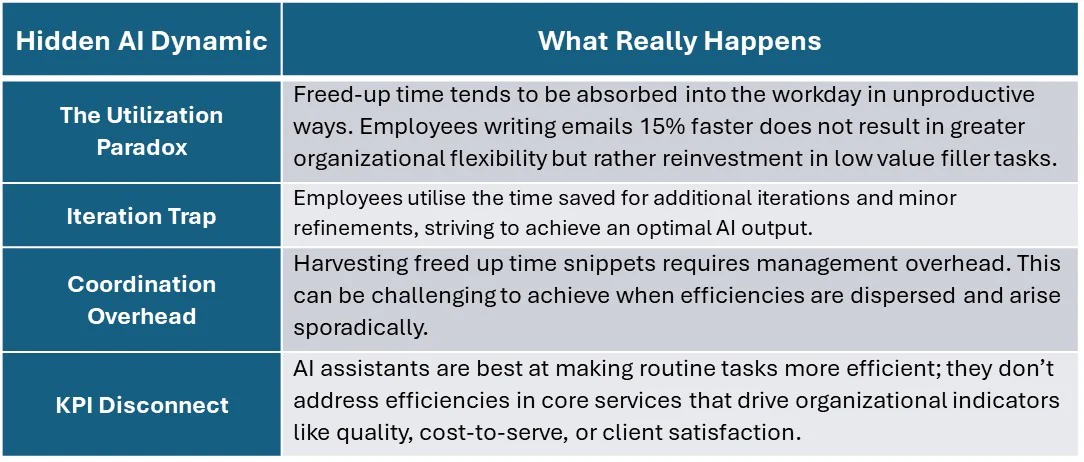
A Case Study: When AI Becomes a Cost Centre
To bring this point home, consider a mid-sized professional services firm that deployed Microsoft 365 Copilot licenses to nearly 900 knowledge workers. Management was told this investment would return hundreds of hours of productivity.
The result after 12 months?
$392,000 in license costs
$110,000 in onboarding and internal governance
Average of 7 minutes saved per day per employee, with no measurable KPI improvement
No increase in client satisfaction, core services delivery, or service quality.
So, while the “savings” were real, they were unstructured and ultimately non-harvestable. No workflows changed. No resourcing adjustments were made. As a result, there was no realized ROI and the program was not scaled further.
Root Causes of Misaligned AI Investments
Why do many organizations fall into the trap of investing in low-impact AI use cases? Several recurring patterns emerge:
Strategy Vacuum: AI tools are purchased to assist with common but non-core issues, not to meet strategic goals.
Embracing Industry Hype: The tendency to give excessive deference to tech industry pitches that promise high ROI without identifying detailed sources of value.
KPI Blindness: Leaders often don't define which business metrics a given tool must improve.
AI-Solutionism: There’s a cultural belief that any AI is better than none, leading to poorly justified spending.
Avoiding the AI Productivity Illusion: A Strategic Approach
To attain genuine AI productivity, organizations should embrace a strategic, benefits-based approach to AI investments. Fundamentally, this entails prioritizing AI adoption efforts focused on core functions and processes and their indicators, rather than routine tasks. Consider the following steps:
Adopt a Strategy-First Lens Every AI use case should map to one or more strategic pillars: e.g. cost reduction, risk mitigation, or citizen/client experience. Resist deploying AI for convenience or personal productivity tasks that don’t map to your organization’s core functionality.
Link to Enterprise KPIs Adopt a benefits-centric approach – demand a business case that projects how it will move the needle on your key performance indicators. It’s not enough to say “it will make people more productive.” Ask: How would we know?
Use a Stage-Gate Approach Don’t scale pilots without proof that productivity gains are accruing to organizational indicators. Move forward only when measurable KPI uplift justifies the spend.
Target Processes, Not Just Tools Embed AI deeply into core processes so that time savings lead to reallocation of work or measurable service improvements.
Track Benefits Continuously Every AI tool should be assessed for actual value delivery at intervals. If it fails to perform, decommission it.
Six Quick Questions for AI Investment Success
Before green-lighting your next AI initiative, ask:
Does this use case align with a measurable strategic objective?
Will the time saved translate into harvestable value?
Will this investment result in improvement to a key performance indicator?
Is there a clear method to evaluate outcomes and measure success?
Can we scale cost-effectively?
Are we building capability — or just subscribing to hype?
Conclusion: Turn Illusion into Impact
There is nothing inherently wrong with AI tools that automate individual tasks. But when such tools become the primary focus of AI adoption, organizations risk mistaking convenience for meaningful impact to core services. Minutes saved are not productivity unless they translate into improved KPIs, reduced costs, or better outcomes for clients and citizens.
Originally published on LinkedIn, April 30, 2025.