Leadership, governance and adoption
The Undelegatable File: Why Deputies Must Personally Lead Their Department's AI Transformation
The AI value squeeze play resolves only at the deputy's desk. Here is the evidence, the reasoning, and how to equip yourself for the job that is not in your background.
Every deputy minister now owns a version of the same conundrum. Budget 2025 booked the pain: roughly sixty billion dollars over five years through the Comprehensive Expenditure Review, and scheduled workforce reductions. This commitment is definitive in scope: enterprise in scale, fixed in schedule and denominated in dollars and positions. Through this, AI was named in the budget's own language as the productivity lever that lets a smaller public service deliver quality and services on par with the pre-budget baseline.
Yet, the delivery reality is anything but definitive. Departmental AI is a scattering of generally small-to-medium sized initiatives, and the record is now well documented: most projects die or stall somewhere prior to production, not because the technology fails or due to lack of conscientiousness, but because of the impossibility of benefits beyond hours saved or employee convenience. Such results are unbankable in terms of mitigating the deputy's conundrum. This leaves the department at higher risk of future backlogs, missed service standards, and diminished program sustainability.
I have written previously about the AI architectural machinery that resolves this: concentrate on high-volume streams, redesign processes end to end, and identify and drive harvestable benefits in bankable denominations. All of this holds true and many organizations understand the mechanisms behind designing AI solutions that drive measurable value to their bottom line. But there is a vital question that determines whether any of that machinery gets built, and that question is what this article is about.
Who, personally, should lead AI transformation?
The answer most departments have given by default is somebody suitably senior, suitably technical, and suitably delegated. This is typically the CIO, CTO, a DG of innovation, or a branch head with energy. The evidence now says this answer is wrong, and that leadership of the AI file belongs on one desk in the building: yours.
What the evidence says
KPMG Global AI Pulse for Q2 2026 shows that organizations whose CEOs assume accountability of AI outcomes are nearly three times more likely to achieve meaningful ROI than those who merely sponsor AI transformation. In other influential work, McKinsey's State of AI survey analysis (March 2025) found that the CEO's personal oversight of AI governance was among the elements most strongly correlated with bottom-line impact from generative AI. And here is the detail that matters for your context: at larger organizations, CEO oversight was the single element with the most impact on value attributable to AI. Yet only twenty-eight percent of surveyed organizations put AI oversight with the chief executive at all, and the share was lower at precisely the large organizations where it matters most.
The surrounding evidence points the same way. McKinsey's November 2025 survey found the roughly six percent of high performers were three times more likely to have senior leaders who actively champion, sponsor, and personally role-model AI use. Its State of Organizations 2026 research (over ten thousand respondents) found that while eighty-eight percent of organizations are experimenting with AI, eighty-one percent report no meaningful bottom-line impact, and only fourteen percent have leaders consistently championing AI with a clear strategy; its conclusion is that AI ROI is a leadership challenge as much as a technical one.
It's true that these reports focus on private-sector organizations. But many of the challenges they describe are common to large, complex, mission-driven institutions. Their findings rest on broadly applicable business principles and translate readily across private and public-sector contexts.
The mechanism: AI delegation fails on authority, not competence
Ask why top-leader ownership would produce harvestable AI value where delegation produces only pilots, and the answer falls out of everything we know about where AI value actually comes from.
The evidence is consistent that the strongest predictor of bottom-line impact is fundamental workflow redesign: rebuilding the end-to-end process around new AI capabilities rather than bolting tools onto tasks. Redesign at that level is what converts real but unbankable gains, e.g. minutes saved at desks, into harvestable denominations: backlogs closed, service standards held, and a department, despite being shrunken through cuts, can maintain its service quality across programs because the work has genuinely changed. And now think about what end-to-end redesign of a major process stream actually requires in a department. It requires: 1) reallocation of people and funding across branch lines, 2) changes to how work is organized, which engages classification and the bargaining agents, 3) a named owner accountable for a benefit that crosses organizational boundaries, 4) multi-year funding protected through annual cycles that want to lapse it, 5) risk appetite set high enough to put a redesigned process into production, and 6) the willingness to kill popular pilots so the high-volume streams get the lion’s share of investment.
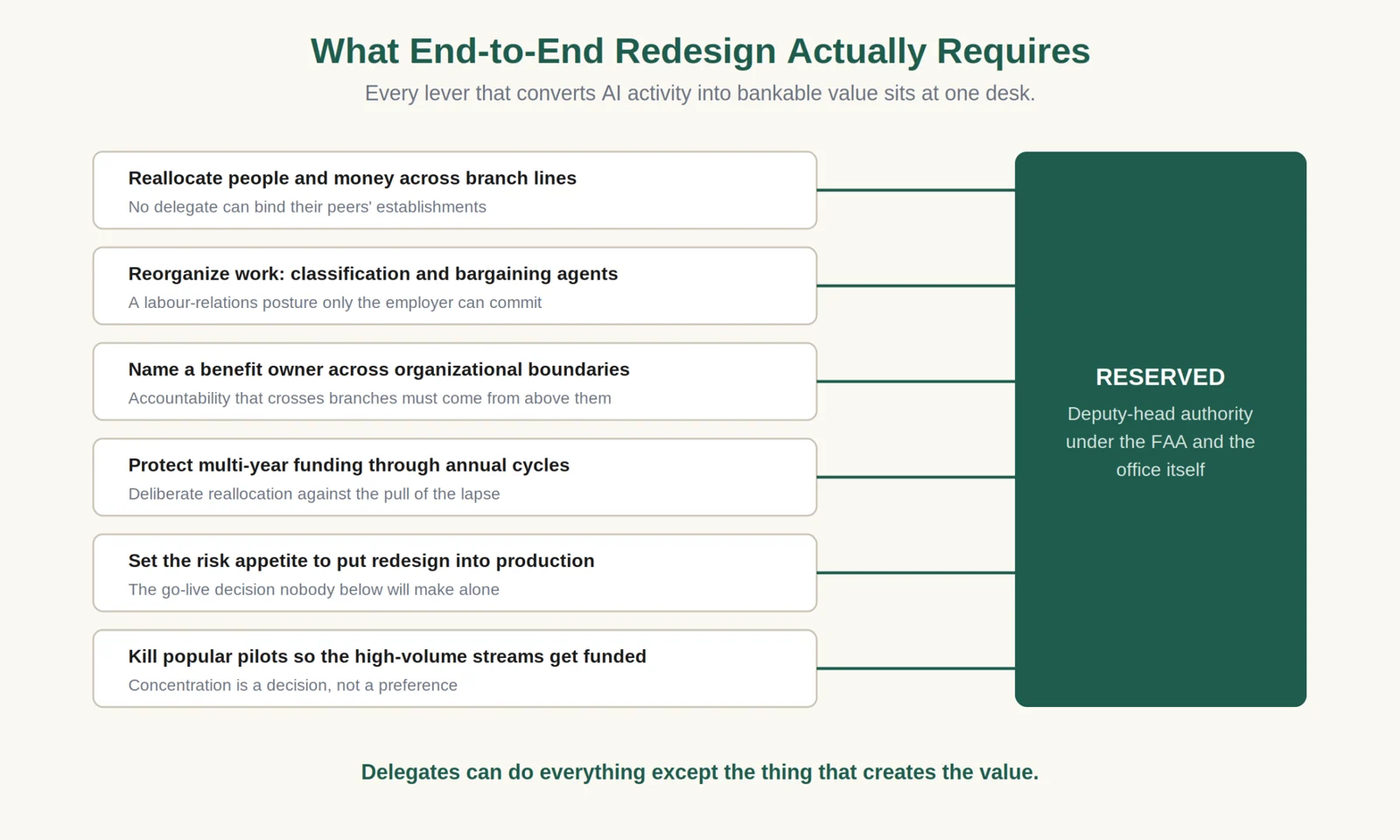
Read that list again and notice what every item has in common. None of it is technical, and all of them are reserved. These are deputy-head authorities, held under the Financial Administration Act and the deputy's position atop the department. They cannot be meaningfully delegated because no delegate can bind their peers. A DG of innovation cannot reallocate another branch's establishment. A CIO cannot commit the department to a labour-relations posture. A chief data officer cannot tell an ADM that her backlog is now the department's primary AI target and her branch will be redesigned around it. When the transformation is delegated, every one of those decisions must travel up, wait, and come back down, and the organization learns quickly that the transformation has less authority than the status quo. That is how a department ends up with forty proofs of concept and no scaled AI operations producing measurable mission value: not through anyone's incompetence, but because the only person holding the levers was not personally on the file.
This is why the delegated model produces exactly the type of portfolio we currently observe. Delegates can do everything except the thing that creates the value.
Why delegation was right before, and is wrong now
None of this is an indictment of any deputy who delegated, because delegation was the correct default for every previous technology wave. ERP, cloud migration, web renewal, network modernization: those changed the plumbing beneath the work, and the work itself carried on above them. A deputy who delegated cloud migration to the CIO was allocating attention rationally. The professional instincts that say "technology files go to the technology leadership" were built on decades of being right.
AI breaks the default because it does not change the plumbing, but changes the work itself: what tasks exist, where judgment sits, how a file moves from intake to decision and what a smaller resource footprint can carry. Changing the work is not a technology program. It is the core of what a department is, and the person accountable for what a department is appears in the Financial Administration Act by title. The playbook has changed; the deputies who ran the old one correctly are not being corrected, they are being handed a new file that cannot go in the delegation matrix.
Personal leadership is not personal management
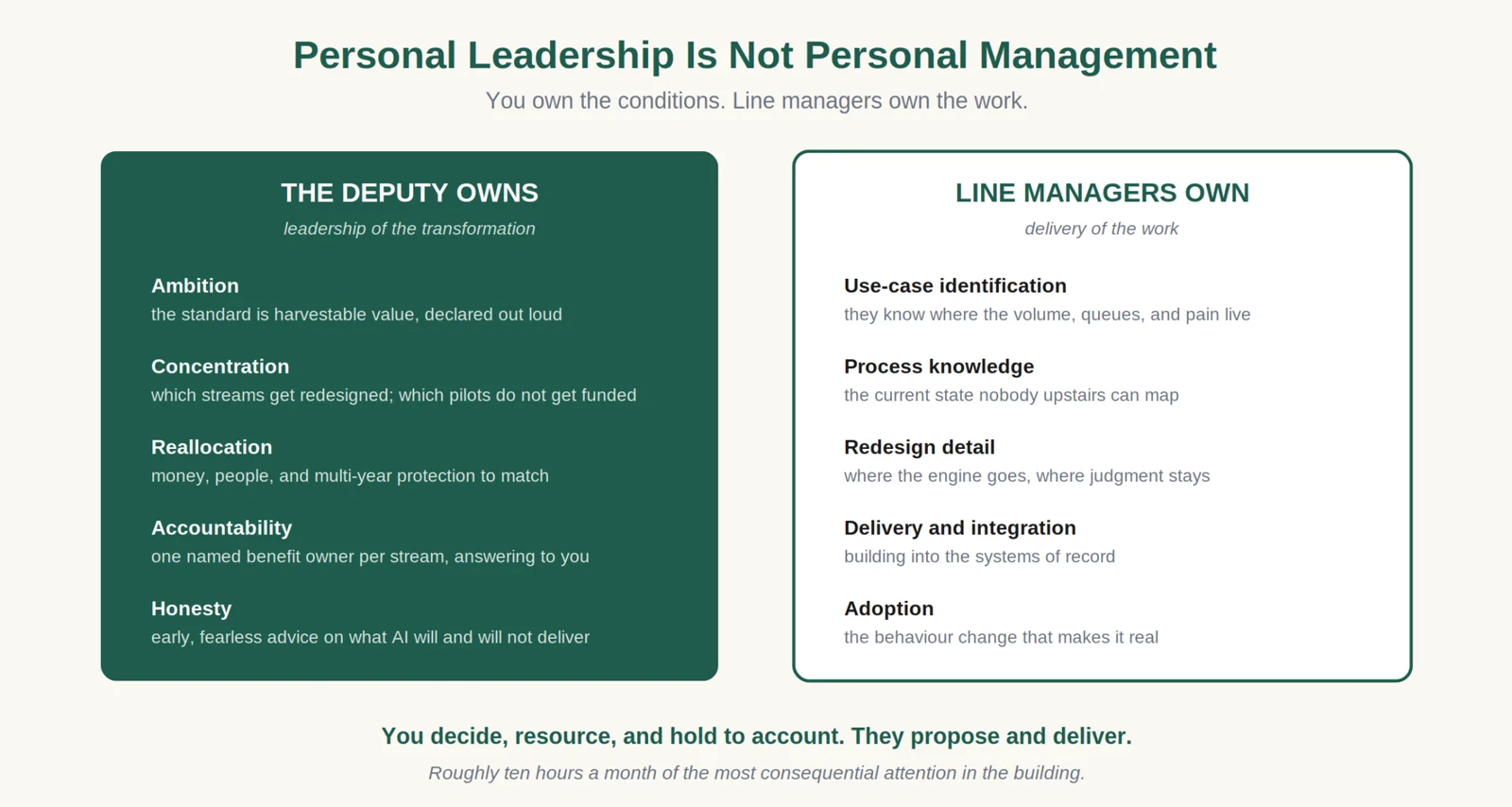
Here the thesis needs its most important boundary, because "the deputy must personally lead" can be misread as a demand for heroic micromanagement, and the evidence explicitly warns against that reading. MIT's 2025 research found that empowering line managers, the people who own the workflows, to drive adoption was a marker of success; the central lab picking use cases was a marker of failure. The people closest to the work know where the volume, the queues, and the pain actually live.
So the division is this. You do not select the use cases, design the systems, or run the projects. You personally own the five things only you can own: the ambition and its public declaration, so the organization knows the standard is harvestable value and not demos; the concentration, deciding which two or three high-volume streams get redesigned and which forty pilots do not get funded; the reallocation, moving money, people, and multi-year protection to match that concentration; the accountability, one named benefit owner per stream, answering to you against a measured baseline; and the honesty, telling your minister early what AI will and will not deliver on the fiscal timeline, because fearless advice does not stop applying when the subject is technical. Line managers propose and deliver. You decide, resource, and hold to account. That is leadership of the transformation, not management of the projects, and it is perhaps ten hours a month of the most consequential attention in the building.
The churn objection, addressed
Any insider will raise this within thirty seconds: deputies rotate, often on cycles shorter than any transformation horizon. A transformation premised on one person is fragile to a rotation that is structurally certain.
Two answers. First, lead personally, institutionalize deliberately. The point of personal leadership is to use the authorities only you hold to build things that outlive your posting: the intake gate, the benefit ledger, the redesigned processes themselves, the governance that reports realized value rather than pilot counts. A transformation properly led for two years is embedded in how the department runs. A transformation delegated for two years is a folder of slideware that leaves when the champion does. Personal leadership is, counterintuitively, the less fragile option.
Second, the clock does not care about the rotation schedule. The Budget 2025 reductions are being implemented now, on a horizon that sits largely inside a single posting. Whoever holds the office when the gap between booked savings and delivered capacity surfaces will answer for it. On this file, the fiscal window has made the accountability personal whether the incumbent embraces it or not. The only choice is whether to lead the file or merely to inherit its outcome.
Equipping yourself: AI transformation is more familiar than it looks
Which brings us to the question every honest deputy will ask, and the one this article exists to answer: how do I lead a transformation in a domain where I have no depth? Here's the playbook:
Start by interrogating the premise. You already run consequential domains without mastery of them. Pay operations, real property, cyber security, and diverse complex programs: no deputy is expert in more than one or two of these, and yet deputies govern them, sometimes through crises, because governing a domain does not require practicing it. It requires knowing which questions expose the truth, being able to calibrate the answers, and having the standing to act on what you learn. The AI file is the same shape. It feels different only because the field is new, the vocabulary is alien, and the vendors are loud. The equipping agenda that follows is therefore not a technical education. It is four investments, and none of them requires technical expertise.
First, use the tools yourself, weekly and personally. This is the one non-negotiable, and it is the item most senior leaders skip. McKinsey's guidance to corporate boards applies with more force to a senior officer: leaders build real fluency by using AI in their own work, preparing for meetings, interrogating documents, drafting and challenging analysis, not by receiving briefings about it. A deputy who has personally watched a model produce a brilliant summary and then confidently invent a citation in the same session has learned, in fifteen minutes, the single most important governance fact about this technology: it is not a faster human, it is an alternative cognitive engine, superhuman in volume and speed, unreliable in ways that are fluent and invisible. That felt knowledge is what lets you calibrate every claim that reaches your desk, from vendors, from enthusiasts, and from your own briefings. It cannot be delegated and it cannot be briefed in. Thirty minutes a week with the sanctioned tools is the cheapest due diligence available to you.
Second, carry two mental models, and require your table to carry them too. #1: AI is not a human analog - it's an alternative cognitive engine with its own strengths and failure modes, so every credible system design places it where volume, speed, and consistency matter and errors are recoverable, keeps humans where judgment, accountability, and high stakes live, and designs the handoff between them by risk. #2: harvestable value lives in the end-to-end process, never in the bolted-on task, because task-level minutes dissolve into the workday while process-level capacity can be banked, defended, and reconciled against booked savings. These two models are the whole conceptual core. Everything else is detail your specialists can hold.
Third, run a leadership learning journey, together and out loud. McKinsey's Rewired research calls taking the top team on a structured learning journey the single most important thing a chief executive can do to accelerate an AI transformation, because it is what carries the leadership from polite endorsement to genuine conviction. In a department this means the executive committee learning as a group: hands on the tools, site visits to the two or three GC operations that have real production systems, a session with the bargaining agents early rather than late, and the deputy visibly a student among students. The signal value of the deputy learning in public is itself a transformation instrument; it licenses every director in the building to say "I don't fully understand this yet" and then go find out.
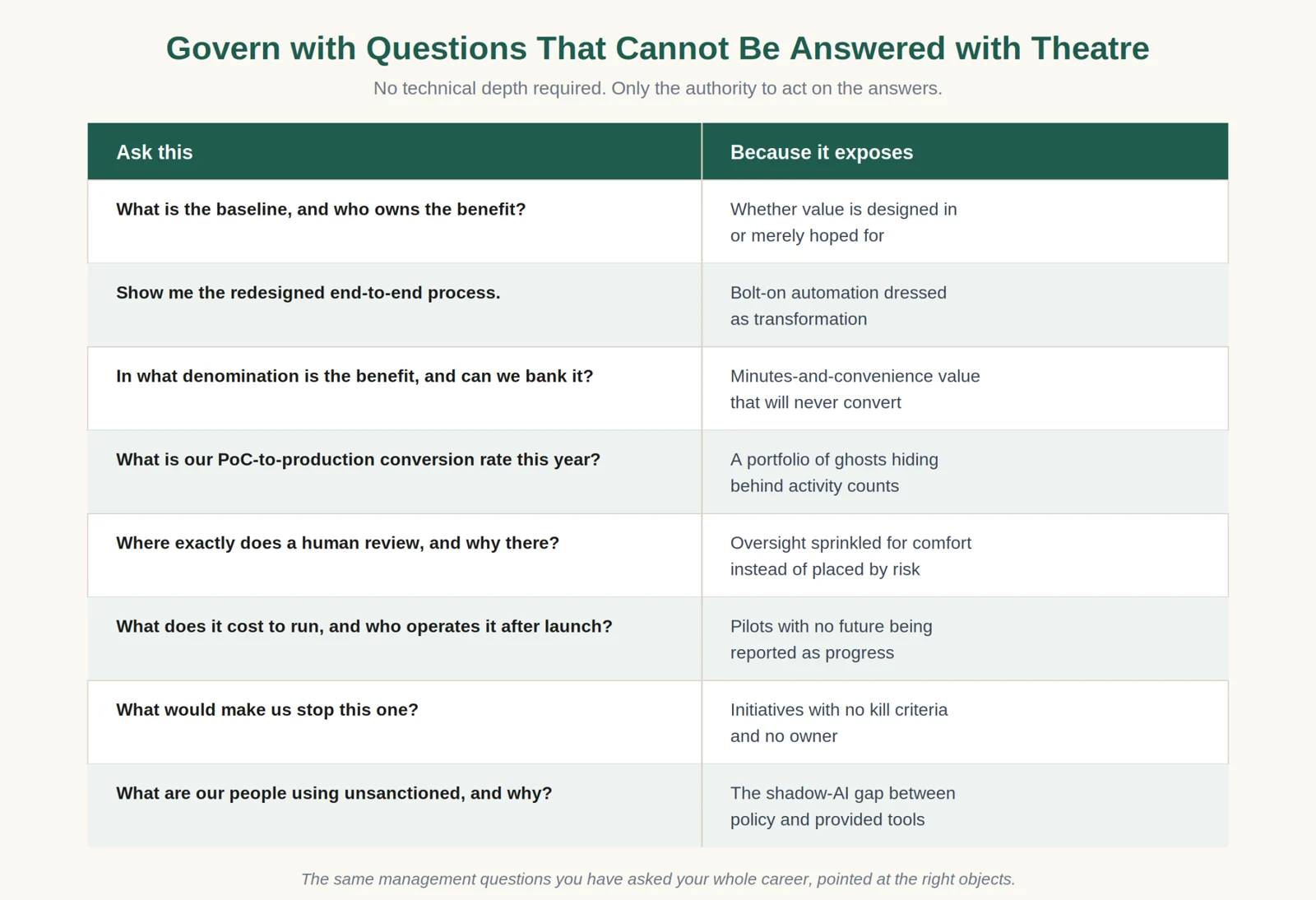
Fourth, govern with questions that cannot be answered with theatre. You do not need to evaluate language models and associated tools. You need a short list of questions whose honest answers reveal everything, asked at your table, in a cadence, with follow-up. They are the same management questions you have honed throughout your career, pointed at the right objects:
The undelegatable file
Put the argument back together. The value mechanism of AI runs through workflow redesign, cross-branch reallocation, benefit accountability, labour-relations engagement, and multi-year protection. Every one of those levers is a deputy-head authority that no delegate can wield. The consistent corporate evidence says AI value concentrates where the top leader personally owns the file. The fiscal clock has made the outcome personal to the office regardless of who leads the work. And the equipping required is not a career change; it is weekly hands-on use, two mental models, a shared learning journey, and eight questions asked relentlessly.
Deputies have absorbed undelegatable files before: official languages, values and ethics, security of information. Each one entered the deputy's personal portfolio when it became clear that the institution's performance on it was a function of the top office's attention. AI transformation has now met that test. The AI squeeze play does not resolve in the CIO shop, the innovation lab, or the delegation matrix. It resolves at your desk, in your calendar, in your questions, and it is far more learnable than it looks from the outside. The good news is that you already know how to run it.
Terry Feltham is a business architect with 35 years of public sector experience and 15 years of experience in machine learning and artificial intelligence.
Originally published on LinkedIn, July 6, 2026.