AI and the public service workforce
A Sneak Peek into the Future of AI in the Public Service
As AI continues to advance, its impact on public service jobs is becoming less a matter of "if" and more a matter of "how and when." Former Clerk of the Privy Council, Michael Wernick, is recently quoted as saying that the greater use of AI could lead to "disruption and displacement of jobs and probably shedding of jobs." He added that with AI, many processes would go "an awful lot faster and with fewer people."
Wernick's remarks are solidly grounded in trends already taking root in the private sector. For instance, companies like IBM and Accenture have announced reductions in their workforce, attributing these cuts directly to the efficiencies gained from AI systems in handling routine administrative tasks. Similarly, companies like Amazon and Microsoft have leveraged AI for customer service chatbots, resulting in the replacement of many call center positions.
As advanced AI begins reshaping the private sector, a pressing question emerges for the public sector: How will these technological advancements transform the Canadian public service? What unique considerations must be addressed, and which roles stand to be most significantly impacted - and on what timeline?
This article aims to analyze current AI trends and their potential impact on the Canadian public service. We'll explore why and how AI could reshape typical job roles, project when these changes might occur, and examine how they could evolve over time.
Motivations for AI in Government
Unlike the profit motive of the private sector, the Federal Government is subject to considerations of service to Canadians and the balance of value versus the cost of services. Some of the factors that will likely motivate more positive consideration of AI by government services planners include:
Operational Efficiency and Cost Savings: AI can streamline numerous processes across departments, sharply reducing administrative burdens and manual tasks such as data entry, report generation, and decision-making support. By automating repetitive tasks, AI can lower operational costs and increase the overall efficiency of government workflows.
Workforce Augmentation and Skill Optimization: AI could allow public service employees to focus on higher-value tasks by handling routine, data-heavy tasks. This could help departments reallocate skilled workers to roles where human judgment, creativity, and problem-solving are needed, allowing for more strategic uses of existing talent.
Improved Decision Making and Data Utilization: The ability of AI to analyze vast amounts of data quickly and spot patterns can help government departments make more informed decisions. AI has the potential to be highly effective in supporting evidence-based policymaking by providing predictive analytics and modeling future scenarios, thus contributing to more effective long-term planning.
Enhanced Service Delivery to Canadians: AI can be used to improve service delivery to Canadians by personalizing and speeding up responses to queries or processing requests. From a Treasury Board perspective, this aligns with the goal of improving public trust and satisfaction with government services.
Other potential advantages to the Government include better cross-departmental collaboration through information sharing, addressing labour shortages by increasing productivity of individual workers, and better risk management through AI's ability to identify patterns.
Overall, these motivations align with the Government's fiscal duty to Canadians to run a cost-conscious yet effective public service. While Treasury Board is still in the process of developing its official AI adoption strategy, these motivations are likely to drive a favourable stance on AI investment and deployment within the public service.
State of AI Technology
It's hard to miss that AI is rapidly improving at skills once considered squarely in the human domain of competence. To put this into perspective, a typical public sector job description consists of a combination of requirements that include domain knowledge, domain experience, and personal suitability. As late as 2021, there was virtually no overlap between AI and human dominated characteristics like judgement, and reasoning and adapting knowledge to new situations. Advanced language models were also highly prone to "hallucinations". That is, if their training in the area queried by the user was insufficiently thorough, they would simply make up a response and present it convincingly as if it were established fact.
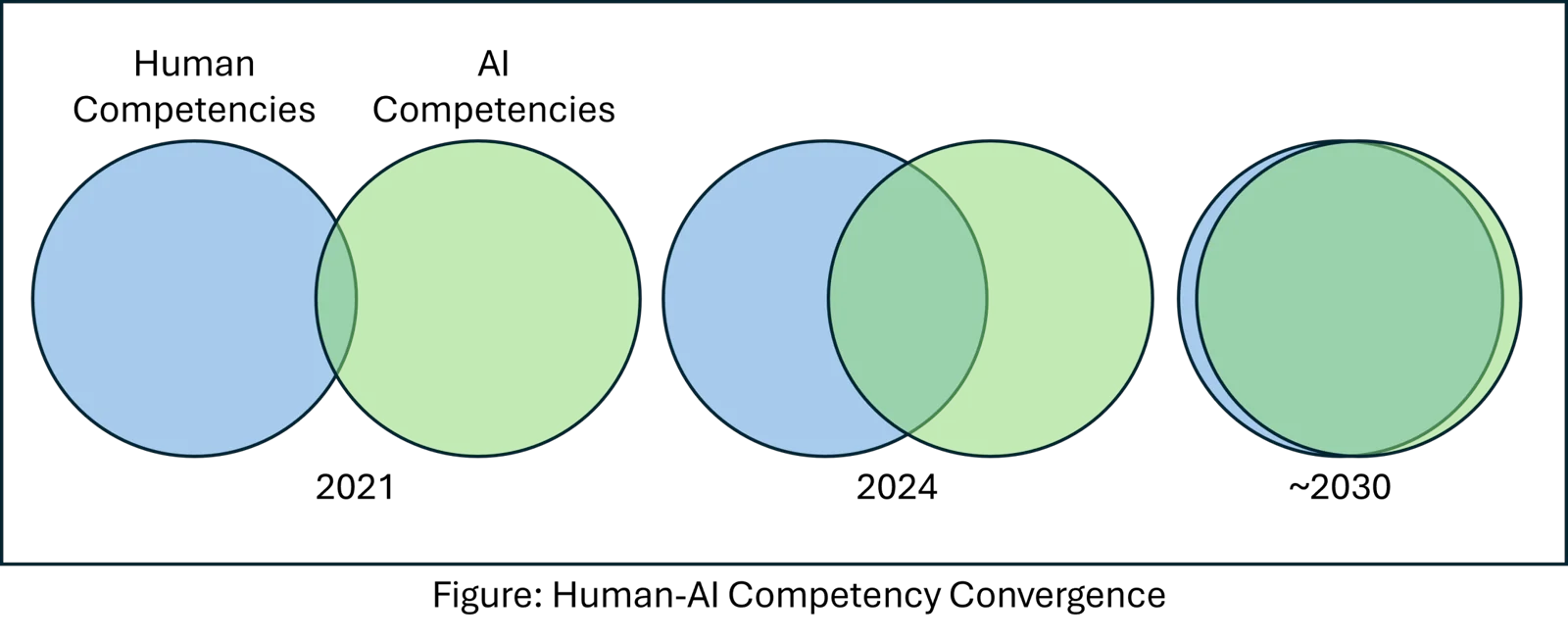
In only three years vast improvements have been made. Leading models such as OpenAI GPT o1 demonstrate PhD-level problem solving skills and can now reason step-by-step across complex problem spaces in a way similar to humans. Also, they can critically evaluate the reasonableness of their responses and revisit their thinking as necessary to optimize their answer. This behaviour greatly reduces hallucinations and increases their ability to act rationally and consistently in a business process setting.
There are still limitations, however. Problems that may seem trivial to a human may pose serious difficulties to an AI. For example, an advanced model that demonstrates PhD-level thinking in abstract mathematics may (amazingly) be unable to correctly count the number of "r"s in the word "strawberry". Such inconsistencies in demonstrating basic intelligence therefore currently restrict AI to the responsibilities of helper or assistant for most business use cases.
This patchwork of gaps in AI capabilities when compared to humans is unlikely to last for long. Given the current rate of progress, many experts estimate only 3-5 years before we arrive at a point where AI will be as good or better than humans across all economically valuable tasks. As we near this point, we’re also likely to see a significant shift in the level of autonomy granted to AI systems in business and government.
While the ultimate pace of AI adoption remains unclear, it is clear that organizational effects in the Canadian public service are almost inevitable. Organizational planners should therefore already be developing an understanding of AI capabilities and limitations in preparation. As AIs become increasingly powerful, planners at all levels will need to understand how to best manage the integration of labour between humans and AI and how to mitigate the inevitable challenges.
A Note on Timing
AI is unlike any tool ever created so in many ways we’ve launched into uncharted waters. Rapid advancements in the field are bringing many new possibilities but just as many questions and uncertainties that go to the root how we value our contribution to the workplace. A natural reaction to uncertainty is to slow down and thoroughly examine the issues. This is likely to be the reaction with AI, especially when it gets to the point where the competence of AI becomes comparable to humans across entire job functions. Other factors could likely affect the rate of AI adoption include:
Budgets – There may be Insufficient funding to roll out AI at the rate the technology would otherwise allow.
Technology – AI models may reach an unforeseen slowing in progress or reach a plateau in competence. Also, technical obstacles in integrating and managing AI in the workplace could cause significant delay.
Public opinion – The emergence of an overall negative public sentiment to AI in business and government could cause arbitrary limits to be imposed on AI proliferation.
Internal resistance – Natural resistance by existing employees over potential job displacement due to AI.
Employment Equity – Initial job displacement would tend toward AS and CR groups which make up about a third of the public service. They are also overwhelmingly made up of female employees so job displacements in these areas could significantly affect Employment Equity targets.
Security – Giving AI access to government systems will require revisiting various security policies and protocols. The studies themselves will take time and may ultimately result in restrictions that limit the functional reach of AI in the workplace.
A Timeline Strawman
Let’s take a look at how AI adoption might proliferate through the Public Service across the next several years. Instead of attempting to incorporate each of the caveats I noted above on timing, I’ll concentrate instead on the pace of AI advancements as the primary driver, as it is the prerequisite before all other considerations can become a factor. The timing I present is therefore skewed toward the technological versus the sociological and so represents a “best case” scenario from the adoption perspective. In short, what I present is a guess, but one that’s rooted in the opinions of several notable thinkers in AI. For added discussion, I’ve associated the example workplace use cases the public service Occupational Groups (OG) most closely associated with them.
We’ll take a look at potential effects across the near term (1-3 years), medium term (3-6 years), and long term (6+ years).
Near Term (1-3 years)
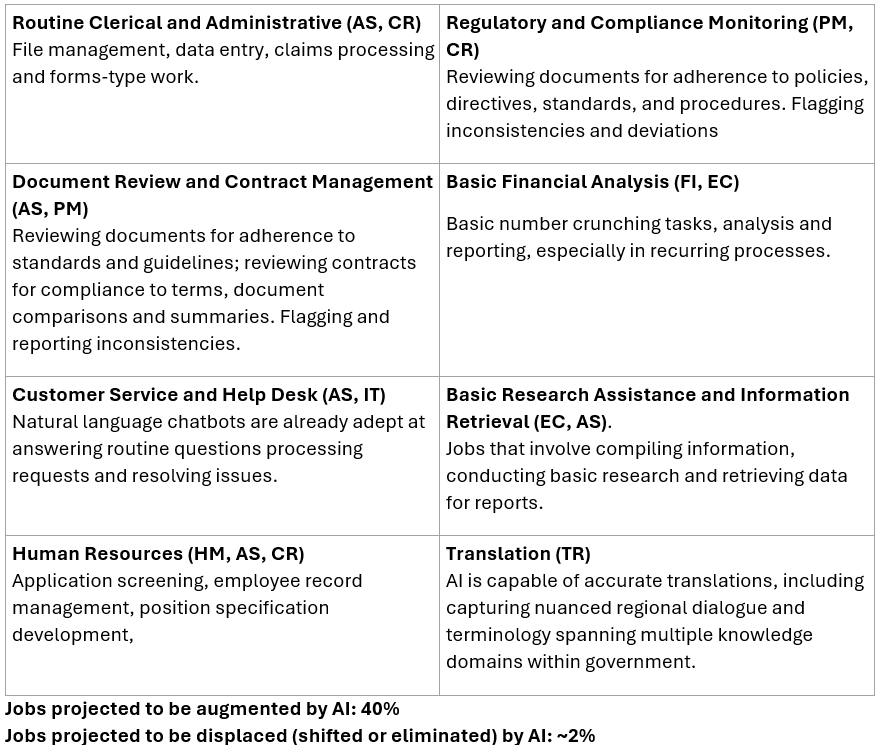
During this period, we can expect to see most departments increase their level experimentation with AI. Most departments will establish AI centers of expertise that will actively search out internal use cases that align with their still limited budgets and domain experience. Consequently, we can expect development of a number AI assistant-type applications. Some will be general purpose chatbot-type applications that can synthesize useful and detailed responses to employee queries on processes, procedures, etc. Other applications will be tuned to specific processes or workflows. These approaches will be primarily aimed at augmenting human performance versus replacing it. With some limited exceptions, few jobs are likely to be fully displaced in this period.
The table below summarizes some of the use cases likely to be actively explored in this period and the affected OGs.
Medium Term (3-6 years)
During this period, AI can be expected to progress from nearing human levels of judgement in end-to-end business processes, to exceeding it in most cases. This means AI will have the ability to dependably replace humans in many day-to-day government business processes and tasks described in the previous table.
AI Centres of expertise will by this point have the experience and advanced tools to implement "digital twins" of employees in certain areas. These twins will be able to replicate the judgement and performance of employees in basic processes and tasks including taking necessary actions. These systems will typically integrate with human teammates through defined governance routines that will alert human supervisors to potential issues should any thresholds be approached.
Many of the AI-augmented job roles discussed in the previous phase will now be in jeopardy of outright displacement. Jobs most at risk will be those that are relatively narrowly defined around a given process or task, such as invoice processing, translation or software development. These and other processes will likely be given almost entirely over to AI and be supervised by human managers.
Meanwhile in this phase, the same advances in understanding, reasoning, and planning, AI will gain greater presence further up the chain of job complexity. They will become useful at augmenting human performance at increasingly higher-level functions and tasks. At this stage, expect AI to augment mid/senior level employees in areas such as the ones below.
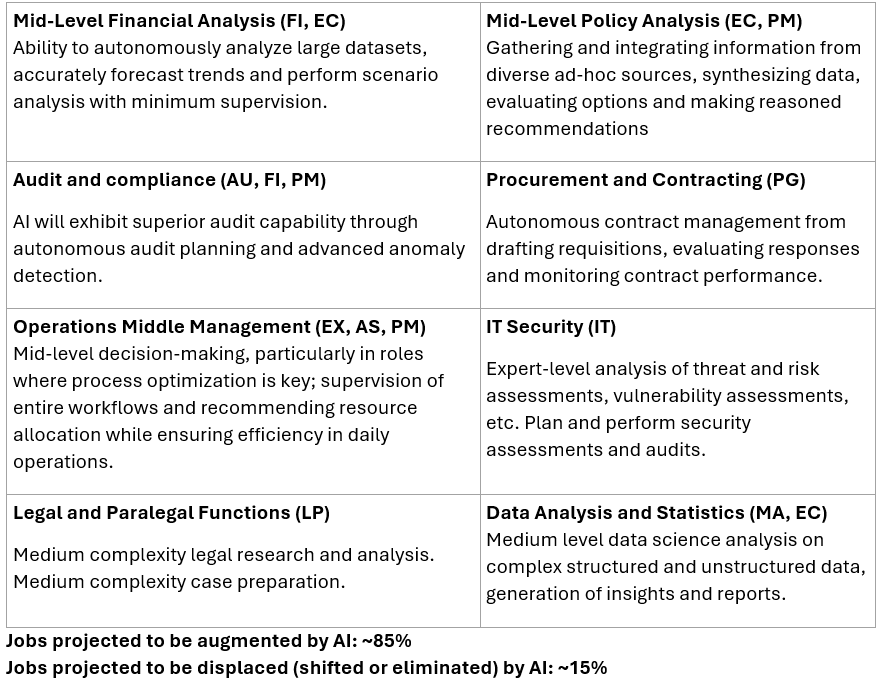
The specificity of the job role will have a significant impact. Jobs that have narrowly defined roles that overlap proven AI capabilities will naturally face a higher likelihood of displacement.
In this phase, we will also begin to see a trend of job consolidation. AI will have effectively displaced significant portions of some jobs but not quite 100% of the role requirements. Several roles will still require human involvement but not at a level that an entire full-time employee could be justified. It's likely that new types of jobs will be developed that specialize in cross-functional
Long Term (6 years +)
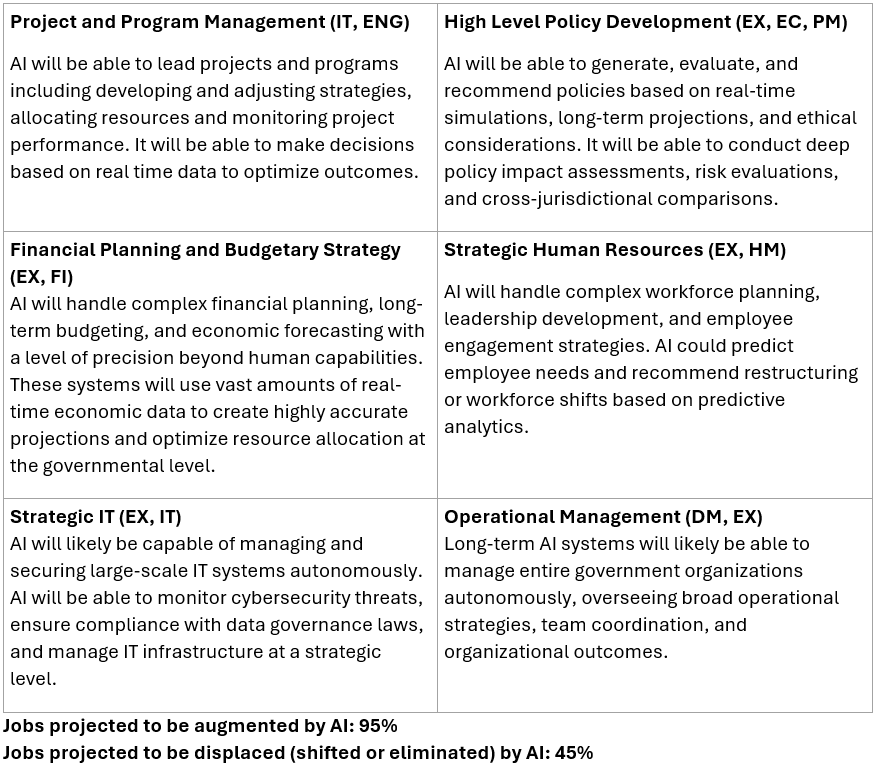
Many industry experts believe that in 6-8 years, we will have entered the era of artificial general intelligence (AGI). At this level of sophistication, AI will exhibit expert-level human performance across most domains. It will handle complex decision-making, higher-order reasoning, and adaptive problem-solving. Importantly, it will exhibit the ability to generalize its understanding and thus be able to apply its learnings from one domain to another. AI will evolve from augmenting human tasks to independently managing complex processes in many areas. At this stage, the scope of job displacement will extend further into higher-skilled and more strategic roles. The following table is a projection of the affected job roles that could be affected and associated OGs.
A Measured Approach to AI in the Public Service
As AI continues to advance, its impact on public service jobs is becoming less a matter of "if" and more a matter of "how and when." Rather than viewing these changes with alarm, it's useful to see them as opportunities to reshape how work gets done in government—enhancing efficiency, improving service, and finding new roles for human talent. While AI will undoubtedly transform many public service roles, the focus should be on thoughtful integration, careful planning, and a commitment to maintaining a high standard of service to Canadians. The journey toward AI adoption is one of adaptation, not just disruption, and those who can proactively engage with these changes will be best positioned to make the most of the opportunities ahead.
Originally published on LinkedIn, October 15, 2024.